EveryBeam MWA integration tests
Goes without saying, but the test here rely on everybeam being installed. First import some code, and up some observational parameters.
import sys
##This is to get hold of EveryBeam on my machine
sys.path.append('/home/jline/software/installed/lib/python3.12/site-packages')
import os
from subprocess import call
from astropy.io import fits
import numpy as np
from astropy.table import Column, Table
from astropy.time import Time
from astropy.coordinates import SkyCoord
from astropy.coordinates import EarthLocation
from astropy import units as u
import matplotlib.pyplot as plt
import numpy.testing as npt
from astropy.constants import c
from astropy.wcs import WCS
import everybeam as eb
from wodenpy.primary_beam.use_everybeam import load_MWA_telescope, load_OSKAR_telescope, load_LOFAR_telescope, run_everybeam, radec_to_xyz, run_everybeam_over_threads
import erfa
import mwa_hyperbeam
from wodenpy.skymodel.read_fits_skymodel import calc_everybeam_for_components
from wodenpy.use_libwoden.create_woden_struct_classes import Woden_Struct_Classes
from ctypes import c_double
from astropy.time import TimeDelta
from wodenpy.array_layout.precession import RTS_Precess_LST_Lat_to_J2000

import sys
sys.path.append('../../scripts/')
from run_woden import main as run_woden

##A bunch of test and plotting code lives here so we can use it in multile notebooks
from eb_testing_code import create_WCS, plot_jones_on_sky, plot_everybeam_on_sky, make_sky_models, read_uvfits, convert_inst_to_stokes, test_stokes_recovery, getFDF, findpeaks, test_RM_recovery, make_RM_skymodel

os.environ["MWA_BEAM_FILE"] = "/home/jline/software/MWA_beam_files/mwa_full_embedded_element_pattern.h5"

C = c.to('m/s').value

# ra0 = 0.0
# dec0 = -26.7
MWA_LAT=-26.703319405555554
MWA_LONG=116.67081523611111

##pick a time/date that sticks our phase centre overhead
date = "2024-07-21T20:13:00"
##Assume that the OSKAR telescope is near the MWA??
mwa_location = EarthLocation(lat=MWA_LAT*u.deg,
                            lon=MWA_LONG*u.deg,
                            height=377.827)
observing_time = Time(date, scale='utc', location=mwa_location)

##Grab the LST
LST = observing_time.sidereal_time('mean')
LST_deg = LST.value*15
# print(f"LST: {LST_deg} deg, RA: {ra0}")
What does the beam look like on the sky?
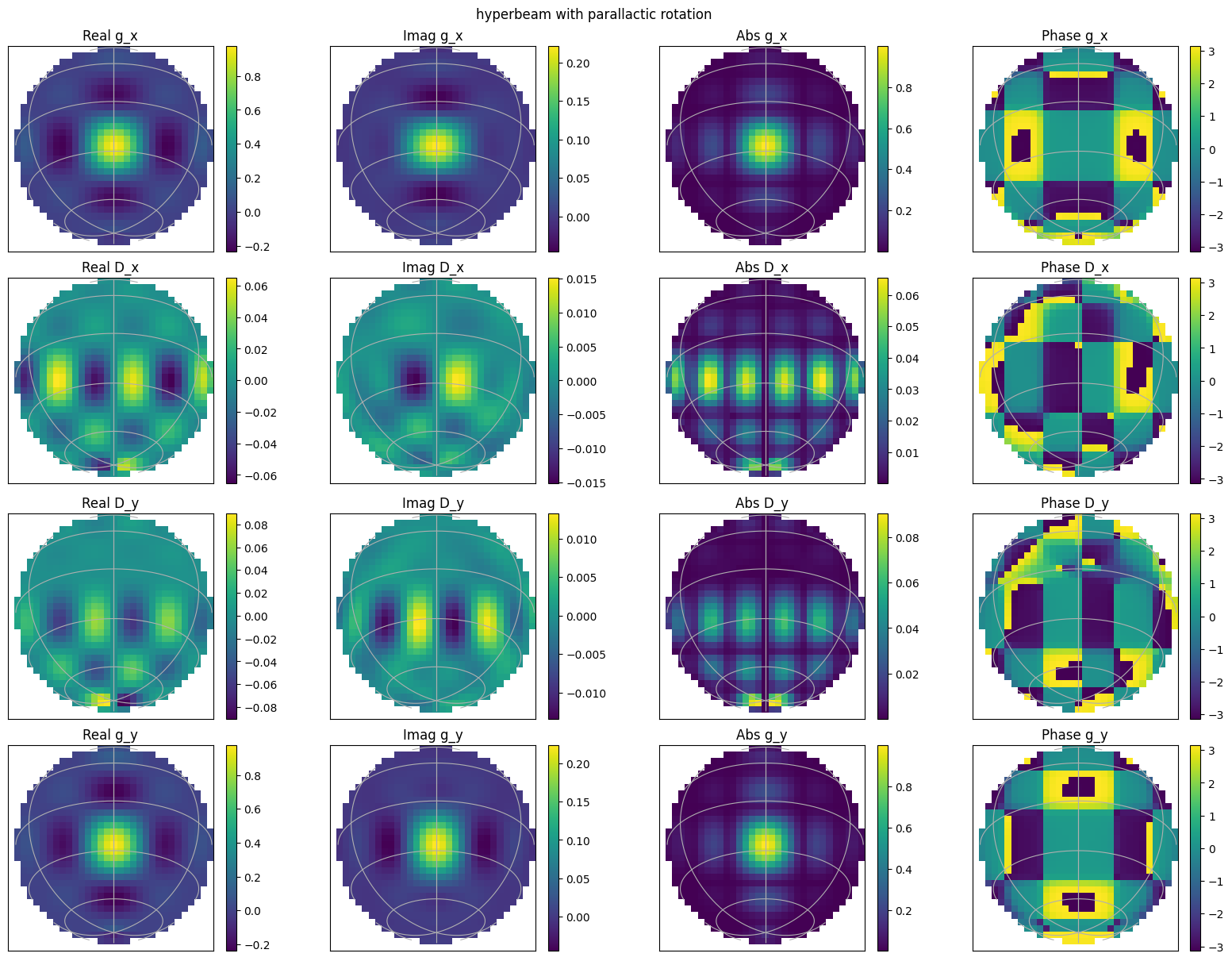
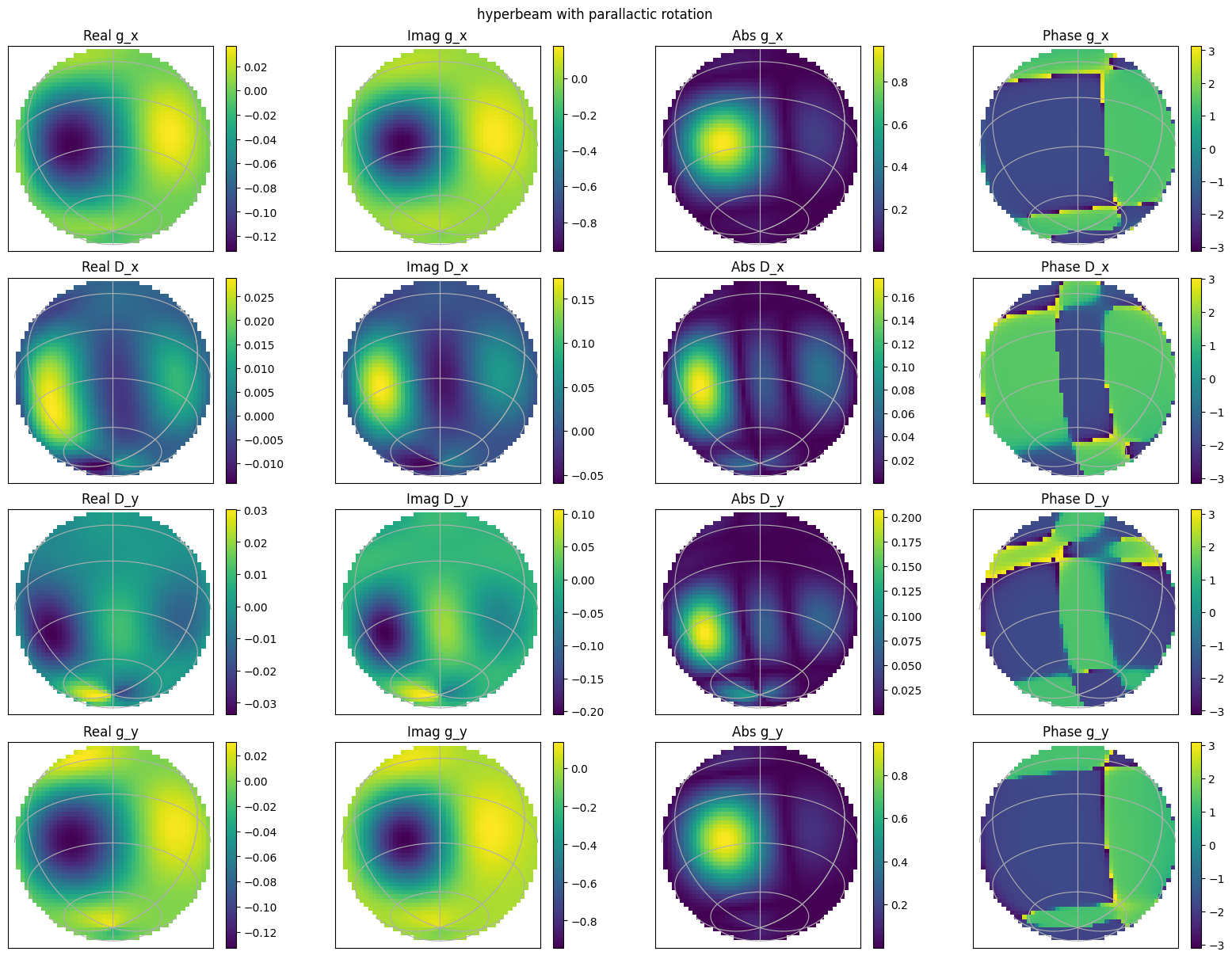
First up, let’s plot the hyperbeam MWA_FEE beam model on the sky to see what we’re expecting. WODEN likes the beam to be in IAU ordering, where the first (often called x) polarisation is aligned north-south. We also want this the have parallactic rotation, so switch that one. We’ll use hyperbeam first, which we already use and have tested extensively within WODEN.
Note that we precess the array and LST back to J2000; this is how WODEN works internally to make everything happen in the J2000 frame. I’m doing it here explicitly to check the beam works in J2000.
##Set up a grid of RA, Dec points

ra0 = LST_deg
dec0 = MWA_LAT

mjd_current = observing_time.mjd


lst_J2000, latitude_J2000 = RTS_Precess_LST_Lat_to_J2000(np.radians(LST_deg),
                                                         np.radians(MWA_LAT),
                                                         mjd_current)


nside=32
radec_reso=120/nside

header, wcs = create_WCS(ra0, dec0, nside, radec_reso)
x_mesh, y_mesh = np.meshgrid(np.arange(nside), np.arange(nside))
ras, decs = wcs.all_pix2world(x_mesh, y_mesh, 0)

ras = np.radians(ras.flatten())
decs = np.radians(decs.flatten())

##Then use erfa to convert these values into azs, els
# has = np.radians(LST_deg) - ras
has = lst_J2000 - ras

##use this erfa function to convert to azimuth and elevation
##were using degrees, but erfa uses rads, so convert here
az_grid, els = erfa.hd2ae(has, decs, latitude_J2000)
za_grid = np.pi/2 - els

##mwa hyperbeam
beam = mwa_hyperbeam.FEEBeam()

freq = 180e+6

parallactic_rotation = True
IAU_order = True

jones = beam.calc_jones_array(az_grid, za_grid, freq, [0]*16, [1]*16,
                              IAU_order, latitude_J2000, parallactic_rotation)

all_gx_hyp = jones[:,0]
all_Dx_hyp = jones[:,1]
all_Dy_hyp = jones[:,2]
all_gy_hyp = jones[:,3]

all_gx_hyp.shape = (nside, nside)
all_Dx_hyp.shape = (nside, nside)
all_Dy_hyp.shape = (nside, nside)
all_gy_hyp.shape = (nside, nside)

plot_jones_on_sky(all_gx_hyp, all_Dx_hyp, all_Dy_hyp, all_gy_hyp, wcs, title="hyperbeam with parallactic rotation")
/home/jline/software/anaconda3/envs/woden_dev/lib/python3.12/site-packages/erfa/core.py:18110: RuntimeWarning: invalid value encountered in hd2ae
  az, el = ufunc.hd2ae(ha, dec, phi)
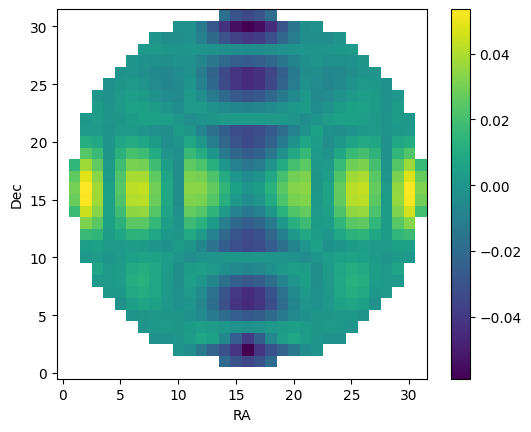
Do a sanity check that we have polarisations in the order that we want. North dipoles are most sensitive towards the East-West, so if we subtract Y from X, we should see a positive signal towards the East-West, and negative towards the North-South.
diff = np.abs(all_gx_hyp) - np.abs(all_gy_hyp)
im = plt.imshow(diff, origin='lower')
plt.colorbar(im)
plt.xlabel("RA")
plt.ylabel("Dec")
plt.show()
Aight, cool, we have a sensible beam patter benchmark to compare against.
EveryBeam MWA
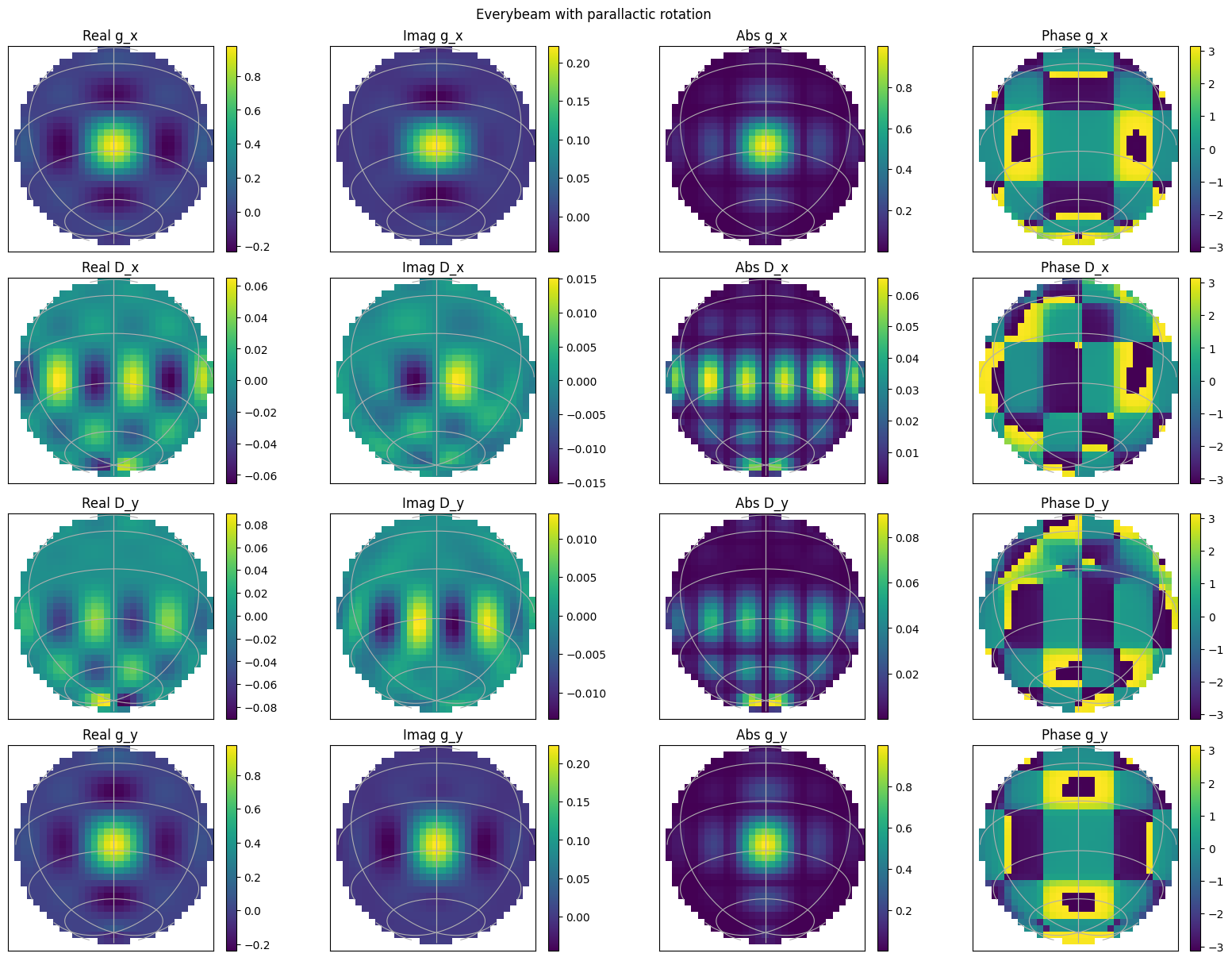
Let’s now do the same with everybeam MWA and see how it compares. We’ll use the wodenpy.use_everybeam.run_everybeam function to do this, which is what the wodenpy sky model reading code uses. However, it’s a fairly slow function, so we’ll run it in parallel over a number of cores. To do this, we’ll use the helper function wodenpy.use_everybeam.run_everybeam_over_threads. This uses the same technique that run_woden.py uses to parallelise the sky model/beam calculations.
##Example MWA MS from the EveryBeam package
ms_path="MWA-single-timeslot.ms"
coeff_path="/home/jline/software/MWA_beam_files/mwa_full_embedded_element_pattern.h5"
station_id = 0
station_ids = [0]
j2000_latitudes = [latitude_J2000]
j2000_lsts = [lst_J2000]
times = [observing_time]
freqs = [freq]
current_latitude = np.radians(MWA_LAT)
current_longitude = np.radians(MWA_LONG)

##The MWA everybeam model seems to pop out normalised beams
apply_beam_norms=False
use_differential_beam=False

##We need to turn on parallactic rotation in wodenpy as it doesn't exist for
##EveryBeam MWA. We also need to reorder the jones to get north-south first
parallactic_rotate=True
reorder_jones=True

##How many cores to split the work over
num_threads=8

all_jones = run_everybeam_over_threads(num_threads, ms_path,
                            coeff_path,
                            ras, decs,
                            np.radians(ra0), np.radians(dec0),
                            j2000_latitudes, j2000_lsts,
                            current_latitude, current_longitude,
                            times, freqs, station_ids,
                            use_differential_beam=use_differential_beam,
                            apply_beam_norms=apply_beam_norms,
                            reorder_jones=reorder_jones,
                            parallactic_rotate=parallactic_rotate,
                            use_local_mwa=True)

beam_ind, time_ind, freq_ind = 0, 0, 0

all_gx_eb = all_jones[beam_ind, time_ind, freq_ind, :, 0, 0]
all_Dx_eb = all_jones[beam_ind, time_ind, freq_ind, :, 0, 1]
all_Dy_eb = all_jones[beam_ind, time_ind, freq_ind, :, 1, 0]
all_gy_eb = all_jones[beam_ind, time_ind, freq_ind, :, 1, 1]

all_gx_eb.shape = (nside, nside)
all_Dx_eb.shape = (nside, nside)
all_Dy_eb.shape = (nside, nside)
all_gy_eb.shape = (nside, nside)

plot_jones_on_sky(all_gx_eb, all_Dx_eb, all_Dy_eb, all_gy_eb, wcs, 'Everybeam with parallactic rotation')
Thread 0 processing coords 0 to 128Thread 5 processing coords 640 to 768Thread 2 processing coords 256 to 384


Thread 6 processing coords 768 to 896Thread 3 processing coords 384 to 512Thread 1 processing coords 128 to 256Thread 7 processing coords 896 to 1024Thread 4 processing coords 512 to 640
/home/jline/software/anaconda3/envs/woden_dev/lib/python3.12/site-packages/erfa/core.py:18110: RuntimeWarning: invalid value encountered in hd2ae
  az, el = ufunc.hd2ae(ha, dec, phi)
/home/jline/software/anaconda3/envs/woden_dev/lib/python3.12/site-packages/erfa/core.py:18110: RuntimeWarning: invalid value encountered in hd2ae
  az, el = ufunc.hd2ae(ha, dec, phi)
/home/jline/software/anaconda3/envs/woden_dev/lib/python3.12/site-packages/erfa/core.py:18110: RuntimeWarning: invalid value encountered in hd2ae
  az, el = ufunc.hd2ae(ha, dec, phi)
/home/jline/software/anaconda3/envs/woden_dev/lib/python3.12/site-packages/erfa/core.py:18110: RuntimeWarning: invalid value encountered in hd2ae
  az, el = ufunc.hd2ae(ha, dec, phi)
/home/jline/software/anaconda3/envs/woden_dev/lib/python3.12/site-packages/erfa/core.py:18110: RuntimeWarning: invalid value encountered in hd2ae
  az, el = ufunc.hd2ae(ha, dec, phi)
/home/jline/software/anaconda3/envs/woden_dev/lib/python3.12/site-packages/erfa/core.py:18110: RuntimeWarning: invalid value encountered in hd2ae
  az, el = ufunc.hd2ae(ha, dec, phi)
/home/jline/software/anaconda3/envs/woden_dev/lib/python3.12/site-packages/erfa/core.py:18110: RuntimeWarning: invalid value encountered in hd2ae
  az, el = ufunc.hd2ae(ha, dec, phi)
/home/jline/software/anaconda3/envs/woden_dev/lib/python3.12/site-packages/erfa/core.py:18110: RuntimeWarning: invalid value encountered in hd2ae
  az, el = ufunc.hd2ae(ha, dec, phi)
Thread 4 finishedThread 7 finished

Thread 2 finished
Thread 3 finished
Thread 5 finished
Thread 1 finished
Thread 0 finished
Thread 6 finished
diff_gx = all_gx_eb - all_gx_hyp
diff_Dx = all_Dx_eb - all_Dx_hyp
diff_Dy = all_Dy_eb - all_Dy_hyp
diff_gy = all_gy_eb - all_gy_hyp

plot_jones_on_sky(diff_gx, diff_Dx, diff_Dy, diff_gy, wcs, 'Difference between everybeam and hyperbeam')
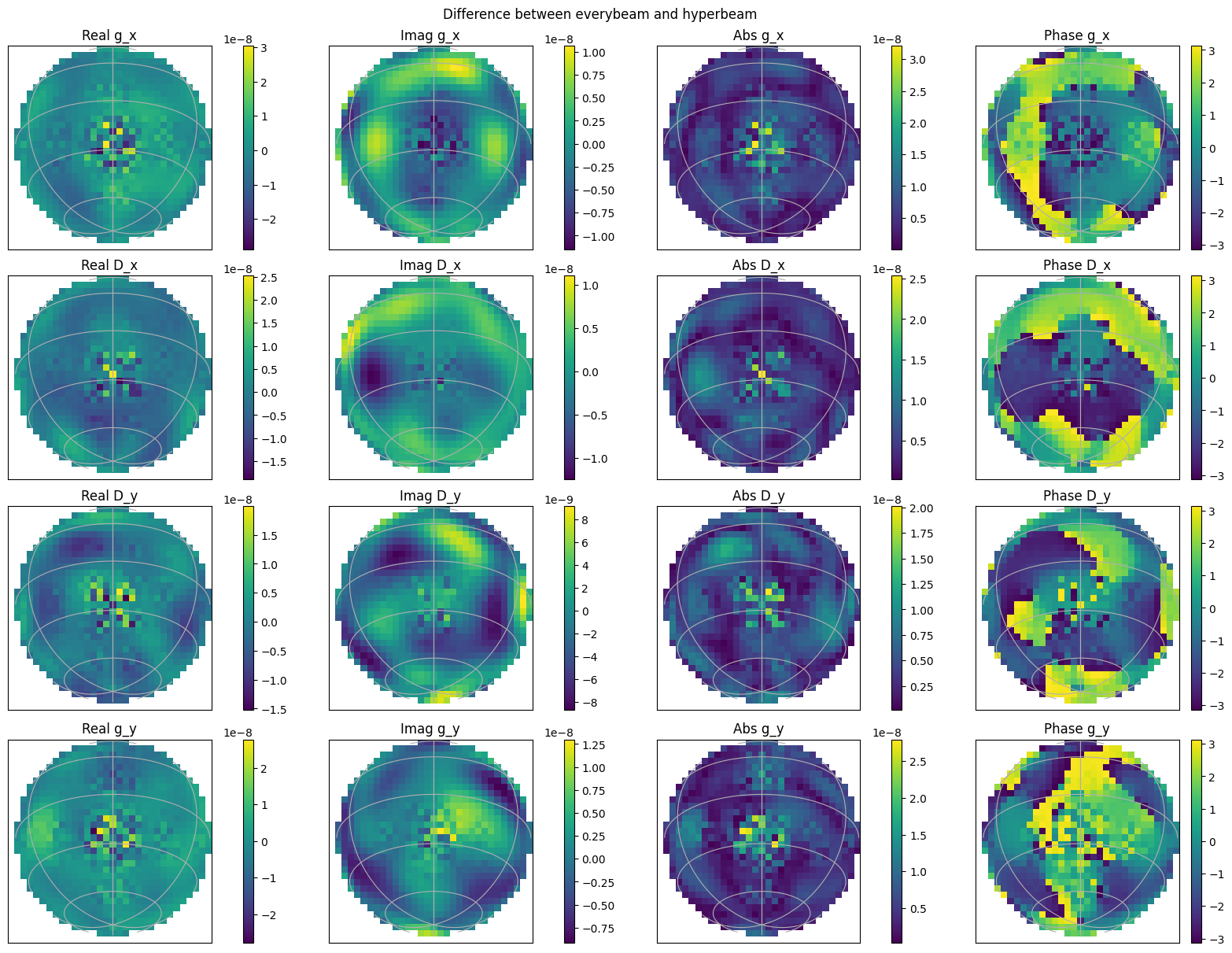
Lovely. Things are looking extremely similar, which is great.
Stokes recovery
Now let’s check that we can recover the Stokes parameters from the beam. We’ll just test a single point source at zenith, where the gains should essentially be 1.0 and leakage zero. We’ll run all Stokes of I, Q, U, V through the full simulator, recombine the linear polarisations, and check we get back what we put in.
First, make our sky models. We’ll make 4 Stokes I models, where each has either I, Q, U, V = 1, and all other Stokes are zero. To make that happen for Q/U, make the component a list type so explicitly set one or the other to zero.
make_sky_models(ra0, dec0)
Keep the simulations tiny by making a 3 ant array
np.random.seed(234987)

##make a random array layout. Source is at phase centre, so the visibilities
##should all be full real and just be set by the flux in the sky
num_antennas = 3
east = np.random.uniform(-1000, 1000, num_antennas)
north = np.random.uniform(-1000, 1000, num_antennas)
height = np.zeros(num_antennas)

array = np.empty((num_antennas, 3))
array[:,0] = east
array[:,1] = north
array[:,2] = height

array_name = "eg_array.txt"
np.savetxt(array_name, array)
Run the 4 different Stokes sky models through hyperbeam first as a point of comparison. We’re avoiding using metafits here to be as apples to apples with EveryBeam as possible.
##parameters for the simulation; setting the date sets an LST of about 0 deg
##to match the phase centre

freq_reso = 1e+6
low_freq = 180e+6
high_freq = 210e+6
num_freq_chans = int((high_freq - low_freq) / freq_reso)

primary_beam = "MWA_FEE"

for pol in ['I', 'Q', 'U', 'V']:

    uvfits_name = f"stokes{pol}_{primary_beam}"
    cat_name = f'{pol}_source.fits'

    args = []

    args.append(f'--ra0={ra0}')
    args.append(f'--dec0={dec0}')
    args.append(f'--array_layout={array_name}')
    args.append(f'--date={date}')
    args.append(f'--output_uvfits_prepend={uvfits_name}')
    args.append(f'--primary_beam={primary_beam}')
    args.append(f'--freq_res={freq_reso}')
    args.append(f'--band_nums=1')
    args.append(f'--num_time_steps=1')
    args.append(f'--IAU_order')
    args.append(f'--cat_filename={cat_name}')
    args.append(f'--lowest_channel_freq={low_freq}')
    args.append(f'--num_freq_channels={num_freq_chans}')
    args.append(f'--time_res=2')
    args.append(f'--MWA_FEE_delays=[0,0,0,0,0,0,0,0,0,0,0,0,0,0,0,0]')
    args.append(f'--num_threads=1')

    run_woden(args)
You are using WODEN commit: No git describe nor __version__ avaible
LOADING IN /home/jline/software/WODEN_dev/wodenpy/libwoden_double.so
Setting phase centre RA,DEC 0.00455deg -26.70332deg
Obs epoch initial LST was 0.0087300922 deg
Setting initial J2000 LST to 359.6931723607 deg
Setting initial mjd to 60512.8423726853
After precession initial latitude of the array is -26.8398178265 deg
We are precessing the array
Doing the initial reading/mapping of sky model into chunks
INFO: couldn't find second table containing shapelet information, so not attempting to load any shapelets.
Mapping took 0.0 mins
Have read in 1 components
After cropping there are 1 components
From Set 0 thread num 0 reading 1 points, 0 gauss, 0 shape, 0 shape coeffs using thread id 0
Finshed thread 0 in 0.0 seconds
Sending set 0 to GPU
Middle freq is 1.80640000e+08
HIP needs this printf otherwise it doesnt work
Set 0 has returned from the GPU after 0.4 seconds
You are using WODEN commit: No git describe nor __version__ avaible
LOADING IN /home/jline/software/WODEN_dev/wodenpy/libwoden_double.so
Setting phase centre RA,DEC 0.00455deg -26.70332deg
Obs epoch initial LST was 0.0087300922 deg
Setting initial J2000 LST to 359.6931723607 deg
Setting initial mjd to 60512.8423726853
After precession initial latitude of the array is -26.8398178265 deg
We are precessing the array
Doing the initial reading/mapping of sky model into chunks
Mapping took 0.0 mins
Have read in 1 components
After cropping there are 1 components
From Set 0 thread num 0 reading 1 points, 0 gauss, 0 shape, 0 shape coeffs using thread id 0
Finshed thread 0 in 0.0 seconds
Sending set 0 to GPU
Middle freq is 1.80640000e+08
HIP needs this printf otherwise it doesnt work
Set 0 has returned from the GPU after 0.1 seconds
You are using WODEN commit: No git describe nor __version__ avaible
LOADING IN /home/jline/software/WODEN_dev/wodenpy/libwoden_double.so
Setting phase centre RA,DEC 0.00455deg -26.70332deg
Obs epoch initial LST was 0.0087300922 deg
Setting initial J2000 LST to 359.6931723607 deg
Setting initial mjd to 60512.8423726853
After precession initial latitude of the array is -26.8398178265 deg
We are precessing the array
Doing the initial reading/mapping of sky model into chunks
Mapping took 0.0 mins
Have read in 1 components
After cropping there are 1 components
From Set 0 thread num 0 reading 1 points, 0 gauss, 0 shape, 0 shape coeffs using thread id 0
Finshed thread 0 in 0.0 seconds
Sending set 0 to GPU
Middle freq is 1.80640000e+08
HIP needs this printf otherwise it doesnt work
Set 0 has returned from the GPU after 0.1 seconds
You are using WODEN commit: No git describe nor __version__ avaible
LOADING IN /home/jline/software/WODEN_dev/wodenpy/libwoden_double.so
Setting phase centre RA,DEC 0.00455deg -26.70332deg
Obs epoch initial LST was 0.0087300922 deg
Setting initial J2000 LST to 359.6931723607 deg
Setting initial mjd to 60512.8423726853
After precession initial latitude of the array is -26.8398178265 deg
We are precessing the array
Doing the initial reading/mapping of sky model into chunks
INFO: couldn't find second table containing shapelet information, so not attempting to load any shapelets.
Mapping took 0.0 mins
Have read in 1 components
After cropping there are 1 components
From Set 0 thread num 0 reading 1 points, 0 gauss, 0 shape, 0 shape coeffs using thread id 0
Finshed thread 0 in 0.0 seconds
Sending set 0 to GPU
Middle freq is 1.80640000e+08
HIP needs this printf otherwise it doesnt work
Set 0 has returned from the GPU after 0.1 seconds
Tests are defined in eb_testing_code.py, which just asserts that whichever Stokes param we set to one comes out as one, and everything else is zero. Make the absolute tolerance of the test something to toggle, because real beam has leakage, and we don’t have the beam at exactly the phase centre for hyperbeam. The Stokes recovery is only really legit when the XX and YY beams are the same, so it’s good at phase centre and zenith.
Do the actual tests for MWA FEE beam
for pol in ['I', 'Q', 'U', 'V']:
    test_stokes_recovery(pol, 'MWA_FEE', atol=5e-3)
Testing Stokes I
Stokes I passed
Testing Stokes Q
Stokes Q passed
Testing Stokes U
Stokes U passed
Testing Stokes V
Stokes V passed
Right, try and do the same thing with EveryBeam
##parameters for the simulation; setting the date sets an LST of about 0 deg
##to match the phase centre

freq_reso = 1e+6
low_freq = 180e+6
high_freq = 210e+6
num_freq_chans = int((high_freq - low_freq) / freq_reso)

primary_beam = "everybeam_MWA"

# print("WHAT DIS", os.environ["MWA_FEE_HDF5"])

for pol in ['I', 'Q', 'U', 'V']:

    uvfits_name = f"stokes{pol}_{primary_beam}"
    cat_name = f'{pol}_source.fits'

    args = []

    args.append(f'--ra0={ra0}')
    args.append(f'--dec0={dec0}')
    args.append(f'--array_layout={array_name}')
    args.append(f'--date={date}')
    args.append(f'--output_uvfits_prepend={uvfits_name}')
    args.append(f'--primary_beam={primary_beam}')
    args.append(f'--beam_ms_path={ms_path}')
    args.append(f'--freq_res={freq_reso}')
    args.append(f'--band_nums=1')
    args.append(f'--num_time_steps=1')
    args.append(f'--IAU_order')
    args.append(f'--station_id=0')
    args.append(f'--cat_filename={cat_name}')
    args.append(f'--lowest_channel_freq={low_freq}')
    args.append(f'--num_freq_channels={num_freq_chans}')
    args.append(f'--time_res=2')
    args.append(f'--num_threads=1')

    run_woden(args)
You are using WODEN commit: No git describe nor __version__ avaible
LOADING IN /home/jline/software/WODEN_dev/wodenpy/libwoden_double.so
Setting phase centre RA,DEC 0.00455deg -26.70332deg
Obs epoch initial LST was 0.0087300922 deg
Setting initial J2000 LST to 359.6931723607 deg
Setting initial mjd to 60512.8423726853
After precession initial latitude of the array is -26.8398178265 deg
We are precessing the array
Doing the initial reading/mapping of sky model into chunks
INFO: couldn't find second table containing shapelet information, so not attempting to load any shapelets.
Mapping took 0.0 mins
Have read in 1 components
After cropping there are 1 components
From Set 0 thread num 0 reading 1 points, 0 gauss, 0 shape, 0 shape coeffs using thread id 0
Finshed thread 0 in 2.3 seconds
Sending set 0 to GPU
Set 0 has returned from the GPU after 0.0 seconds
You are using WODEN commit: No git describe nor __version__ avaible
LOADING IN /home/jline/software/WODEN_dev/wodenpy/libwoden_double.so
Setting phase centre RA,DEC 0.00455deg -26.70332deg
Obs epoch initial LST was 0.0087300922 deg
Setting initial J2000 LST to 359.6931723607 deg
Setting initial mjd to 60512.8423726853
After precession initial latitude of the array is -26.8398178265 deg
We are precessing the array
Doing the initial reading/mapping of sky model into chunks
Mapping took 0.0 mins
Have read in 1 components
After cropping there are 1 components
From Set 0 thread num 0 reading 1 points, 0 gauss, 0 shape, 0 shape coeffs using thread id 0
Finshed thread 0 in 2.3 seconds
Sending set 0 to GPU
Set 0 has returned from the GPU after 0.0 seconds
You are using WODEN commit: No git describe nor __version__ avaible
LOADING IN /home/jline/software/WODEN_dev/wodenpy/libwoden_double.so
Setting phase centre RA,DEC 0.00455deg -26.70332deg
Obs epoch initial LST was 0.0087300922 deg
Setting initial J2000 LST to 359.6931723607 deg
Setting initial mjd to 60512.8423726853
After precession initial latitude of the array is -26.8398178265 deg
We are precessing the array
Doing the initial reading/mapping of sky model into chunks
Mapping took 0.0 mins
Have read in 1 components
After cropping there are 1 components
From Set 0 thread num 0 reading 1 points, 0 gauss, 0 shape, 0 shape coeffs using thread id 0
Finshed thread 0 in 2.4 seconds
Sending set 0 to GPU
Set 0 has returned from the GPU after 0.0 seconds
You are using WODEN commit: No git describe nor __version__ avaible
LOADING IN /home/jline/software/WODEN_dev/wodenpy/libwoden_double.so
Setting phase centre RA,DEC 0.00455deg -26.70332deg
Obs epoch initial LST was 0.0087300922 deg
Setting initial J2000 LST to 359.6931723607 deg
Setting initial mjd to 60512.8423726853
After precession initial latitude of the array is -26.8398178265 deg
We are precessing the array
Doing the initial reading/mapping of sky model into chunks
INFO: couldn't find second table containing shapelet information, so not attempting to load any shapelets.
Mapping took 0.0 mins
Have read in 1 components
After cropping there are 1 components
From Set 0 thread num 0 reading 1 points, 0 gauss, 0 shape, 0 shape coeffs using thread id 0
Finshed thread 0 in 2.6 seconds
Sending set 0 to GPU
Set 0 has returned from the GPU after 0.0 seconds
for pol in ['I', 'Q', 'U', 'V']:
    test_stokes_recovery(pol, 'everybeam_MWA', atol=5e-3)

    ##Uncomment to print out example values
    # uvfits_name = f"stokes{pol}_everybeam_MWA"
    # XX, XY, YX, YY = read_uvfits(f'{uvfits_name}_band01.uvfits')
    # ##pick a random baseline to plot, they should all be the sam
    # baseline = 0

    # recover_I, recover_Q, recover_U, recover_V = convert_inst_to_stokes(XX[baseline], XY[baseline], YX[baseline], YY[baseline])
    # print(f"{pol}, {recover_I[0].real:.2f}, {recover_Q[0].real:.2f}, {recover_U[0].real:.2f}, {recover_V[0].real:.2f}")
Testing Stokes I
Stokes I passed
Testing Stokes Q
Stokes Q passed
Testing Stokes U
Stokes U passed
Testing Stokes V
Stokes V passed
Now test an RM recovery
Check we recover the correct RM and sign for a linearly polarised source. First of all, make the sky model.
phi_RM, pol_frac = make_RM_skymodel(ra0, dec0)
Run that through WODEN using hyperbeam to check the test is working.
freq_reso = 0.1e+6
low_freq = 180e+6
high_freq = 210e+6
num_freq_chans = int((high_freq - low_freq) / freq_reso)


primary_beam = "MWA_FEE"

uvfits_name = f"rm_source_{primary_beam}"
cat_name = 'RM_source.fits'

args = []

args.append(f'--ra0={ra0}')
args.append(f'--dec0={dec0}')
args.append(f'--array_layout={array_name}')
args.append(f'--date={date}')
args.append(f'--output_uvfits_prepend={uvfits_name}')
args.append(f'--primary_beam={primary_beam}')
args.append(f'--freq_res={freq_reso}')
args.append(f'--band_nums=1')
args.append(f'--num_time_steps=1')
args.append(f'--IAU_order')
args.append(f'--MWA_FEE_delays=[0,0,0,0,0,0,0,0,0,0,0,0,0,0,0,0]')
args.append(f'--cat_filename={cat_name}')
args.append(f'--lowest_channel_freq={low_freq}')
args.append(f'--num_freq_channels={num_freq_chans}')
args.append(f'--time_res=2')
args.append(f'--num_threads=1')

run_woden(args)
You are using WODEN commit: No git describe nor __version__ avaible
LOADING IN /home/jline/software/WODEN_dev/wodenpy/libwoden_double.so
Setting phase centre RA,DEC 0.00455deg -26.70332deg
Obs epoch initial LST was 0.0087300922 deg
Setting initial J2000 LST to 359.6931723607 deg
Setting initial mjd to 60512.8423726853
After precession initial latitude of the array is -26.8398178265 deg
We are precessing the array
Doing the initial reading/mapping of sky model into chunks
INFO: couldn't find second table containing shapelet information, so not attempting to load any shapelets.
Mapping took 0.0 mins
Have read in 1 components
After cropping there are 1 components
From Set 0 thread num 0 reading 1 points, 0 gauss, 0 shape, 0 shape coeffs using thread id 0
Finshed thread 0 in 0.0 seconds
Sending set 0 to GPU
Middle freq is 1.80640000e+08
HIP needs this printf otherwise it doesnt work
Set 0 has returned from the GPU after 0.1 seconds
Have a look and check our visis make sense
XX, XY, YX, YY = read_uvfits('rm_source_MWA_FEE_band01.uvfits')
baseline = 0
recover_I, recover_Q, recover_U, recover_V = convert_inst_to_stokes(XX[baseline], XY[baseline], YX[baseline], YY[baseline])


freqs = np.arange(low_freq, high_freq, freq_reso)

fig, axs = plt.subplots(1, 1, figsize=(8, 6))

axs.plot(freqs / 1e+6, recover_I.real, 'k-', label='Recovered I')
axs.plot(freqs / 1e+6, recover_Q.real, 'r', label='Recovered Q')
axs.plot(freqs / 1e+6, recover_U.real, 'b', label='Recovered U')
axs.plot(freqs / 1e+6, recover_V.real, 'g', label='Recovered V')

axs.legend()

axs.set_xlabel('Frequency (MHz)')
axs.set_ylabel('Flux (Jy)')

plt.show()

# fig, axs = plt.subplots(1, 1, figsize=(8, 6))
# axs.plot(freqs / 1e+6, recover_I.real, 'k-', label='Polarisation Fraction')
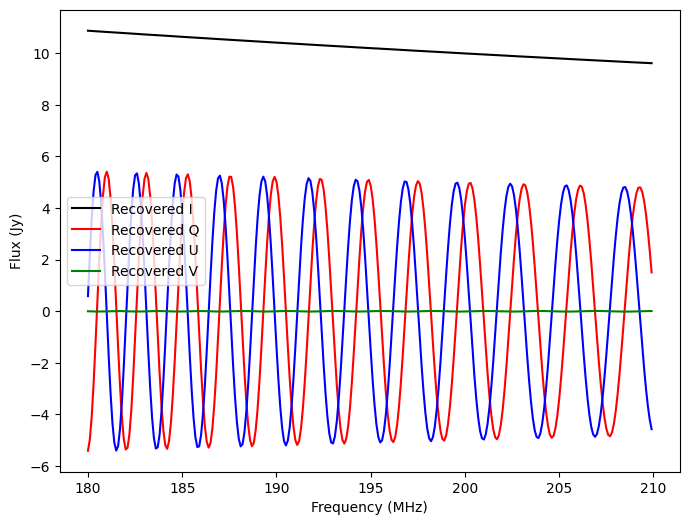
Now define a test, using a bunch of Emil’s RM synthesis code.
test_RM_recovery(uvfits_name, phi_RM, pol_frac, freqs)
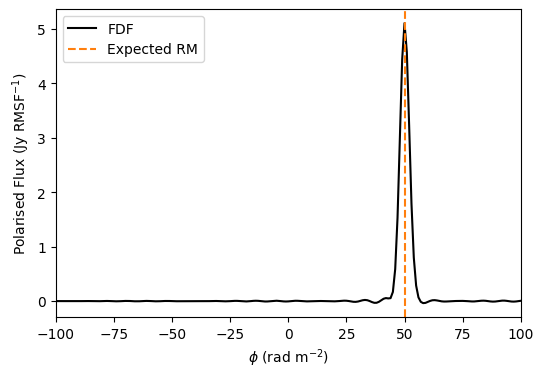
Recovered RM: 50.0 Expected RM: 50
Recovered Pol. Fraction: 0.49999538 Expected Pol Fraction 0.5
Loverly, works a treat. Now let’s do that with EveryBeam.
freq_reso = 0.1e+6
low_freq = 180e+6
high_freq = 210e+6
num_freq_chans = int((high_freq - low_freq) / freq_reso)

primary_beam = "everybeam_MWA"
uvfits_name = f"rm_source_{primary_beam}"
cat_name = 'RM_source.fits'

args = []

args.append(f'--ra0={ra0}')
args.append(f'--dec0={dec0}')
args.append(f'--array_layout={array_name}')
args.append(f'--date={date}')
args.append(f'--output_uvfits_prepend={uvfits_name}')
args.append(f'--primary_beam={primary_beam}')
args.append(f'--beam_ms_path={ms_path}')
args.append(f'--freq_res={freq_reso}')
args.append(f'--band_nums=1')
args.append(f'--num_time_steps=1')
args.append(f'--IAU_order')
args.append(f'--station_id=0')
args.append(f'--cat_filename={cat_name}')
args.append(f'--lowest_channel_freq={low_freq}')
args.append(f'--num_freq_channels={num_freq_chans}')
args.append(f'--time_res=2')
args.append(f'--num_threads=1')

run_woden(args)
You are using WODEN commit: No git describe nor __version__ avaible
LOADING IN /home/jline/software/WODEN_dev/wodenpy/libwoden_double.so
Setting phase centre RA,DEC 0.00455deg -26.70332deg
Obs epoch initial LST was 0.0087300922 deg
Setting initial J2000 LST to 359.6931723607 deg
Setting initial mjd to 60512.8423726853
After precession initial latitude of the array is -26.8398178265 deg
We are precessing the array
Doing the initial reading/mapping of sky model into chunks
INFO: couldn't find second table containing shapelet information, so not attempting to load any shapelets.
Mapping took 0.0 mins
Have read in 1 components
After cropping there are 1 components
From Set 0 thread num 0 reading 1 points, 0 gauss, 0 shape, 0 shape coeffs using thread id 0
Finshed thread 0 in 24.6 seconds
Sending set 0 to GPU
Set 0 has returned from the GPU after 0.0 seconds
XX, XY, YX, YY = read_uvfits('rm_source_everybeam_MWA_band01.uvfits')
baseline = 0
recover_I, recover_Q, recover_U, recover_V = convert_inst_to_stokes(XX[baseline], XY[baseline], YX[baseline], YY[baseline])


freqs = np.arange(low_freq, high_freq, freq_reso)

fig, axs = plt.subplots(1, 1, figsize=(8, 6))

axs.plot(freqs / 1e+6, recover_I.real, 'k-', label='Recovered I')
axs.plot(freqs / 1e+6, recover_Q.real, 'r', label='Recovered Q')
axs.plot(freqs / 1e+6, recover_U.real, 'b', label='Recovered U')
axs.plot(freqs / 1e+6, recover_V.real, 'g', label='Recovered V')

axs.legend()

axs.set_xlabel('Frequency (MHz)')
axs.set_ylabel('Flux (Jy)')

plt.show()
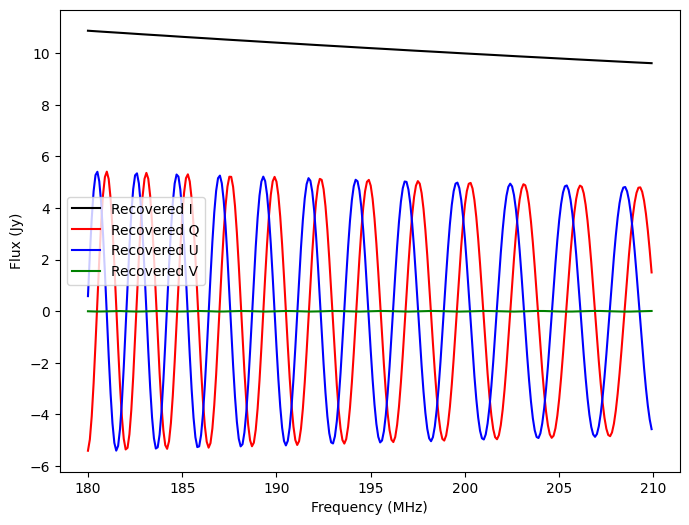
Looks good!
test_RM_recovery(uvfits_name, phi_RM, pol_frac, freqs)
Recovered RM: 50.0 Expected RM: 50
Recovered Pol. Fraction: 0.49999538 Expected Pol Fraction 0.5
Yup works woot
Test antenna locations
Now check to see if the antenna locations are read in correctly from a measurement set. We’ll run WODEN using the a metafits file first, and then using a measurement set that came out of hyperdrive which is calibrated data that matches the observation of the metafits. Hopefully they match up.
phi_RM, pol_frac = make_RM_skymodel(ra0, dec0)
ra0 = 60.0
date = "2015-09-10T19:44:15"

freq_reso = 0.1e+6
low_freq = 180e+6
num_freq_chans = 1

primary_beam = "MWA_FEE"

uvfits_name = f"ant_locs_{primary_beam}"
cat_name = 'RM_source.fits'

args = []

args.append(f'--ra0={ra0}')
args.append(f'--dec0={dec0}')
args.append(f'--date={date}')
args.append(f'--output_uvfits_prepend={uvfits_name}')
args.append(f'--metafits_filename=../../examples/metafits/1125949472_metafits.fits')
args.append(f'--primary_beam={primary_beam}')
args.append(f'--freq_res={freq_reso}')
args.append(f'--band_nums=1')
args.append(f'--num_time_steps=1')
args.append(f'--IAU_order')
args.append(f'--cat_filename={cat_name}')
args.append(f'--lowest_channel_freq={low_freq}')
args.append(f'--num_freq_channels={num_freq_chans}')
args.append(f'--time_res=2')
args.append(f'--MWA_FEE_delays=[0,0,0,0,0,0,0,0,0,0,0,0,0,0,0,0]')
args.append(f'--num_threads=1')

run_woden(args)
You are using WODEN commit: No git describe nor __version__ avaible
LOADING IN /home/jline/software/WODEN_dev/wodenpy/libwoden_double.so
Setting phase centre RA,DEC 60.00000deg -26.70332deg
Obs epoch initial LST was 42.2620215148 deg
Setting initial J2000 LST to 42.0911874758 deg
Setting initial mjd to 57275.8224074073
After precession initial latitude of the array is -26.7665041369 deg
We are precessing the array
Doing the initial reading/mapping of sky model into chunks
INFO: couldn't find second table containing shapelet information, so not attempting to load any shapelets.
Mapping took 0.0 mins
Have read in 1 components
After cropping there are 1 components
From Set 0 thread num 0 reading 1 points, 0 gauss, 0 shape, 0 shape coeffs using thread id 0
Finshed thread 0 in 0.0 seconds
Sending set 0 to GPU
Middle freq is 1.80640000e+08
HIP needs this printf otherwise it doesnt work
Set 0 has returned from the GPU after 0.0 seconds
primary_beam = "everybeam_MWA"

uvfits_name = f"ant_locs_{primary_beam}"
cat_name = 'RM_source.fits'

ms_path = '/mnt/c/Users/jackl/Dropbox/work/test_WODEN/everybeam/run_MWA_beam/hypcal_1125949472.ms'


args = []

args.append(f'--ra0={ra0}')
args.append(f'--dec0={dec0}')
args.append(f'--date={date}')
args.append(f'--output_uvfits_prepend={uvfits_name}')
args.append(f'--primary_beam={primary_beam}')
args.append(f'--beam_ms_path={ms_path}')
args.append(f'--freq_res={freq_reso}')
args.append(f'--band_nums=1')
args.append(f'--num_time_steps=1')
args.append(f'--IAU_order')
args.append(f'--station_id=0')
args.append(f'--cat_filename={cat_name}')
args.append(f'--lowest_channel_freq={low_freq}')
args.append(f'--num_freq_channels={num_freq_chans}')
args.append(f'--time_res=2')

run_woden(args)
Successful readonly open of default-locked table /mnt/c/Users/jackl/Dropbox/work/test_WODEN/everybeam/run_MWA_beam/hypcal_1125949472.ms/ANTENNA: 13 columns, 128 rows
You are using WODEN commit: No git describe nor __version__ avaible
LOADING IN /home/jline/software/WODEN_dev/wodenpy/libwoden_double.so
Setting phase centre RA,DEC 60.00000deg -26.70332deg
Obs epoch initial LST was 42.2620215148 deg
Setting initial J2000 LST to 42.0911874758 deg
Setting initial mjd to 57275.8224074073
After precession initial latitude of the array is -26.7665041369 deg
We are precessing the array
Doing the initial reading/mapping of sky model into chunks
INFO: couldn't find second table containing shapelet information, so not attempting to load any shapelets.
Mapping took 0.0 mins
Have read in 1 components
After cropping there are 1 components
From Set 0 thread num 0 reading 1 points, 0 gauss, 0 shape, 0 shape coeffs using thread id 0From Set 0 thread num 1 reading 0 points, 0 gauss, 0 shape, 0 shape coeffs using thread id 1From Set 0 thread num 2 reading 0 points, 0 gauss, 0 shape, 0 shape coeffs using thread id 2
From Set 0 thread num 3 reading 0 points, 0 gauss, 0 shape, 0 shape coeffs using thread id 3
From Set 0 thread num 4 reading 0 points, 0 gauss, 0 shape, 0 shape coeffs using thread id 4From Set 0 thread num 5 reading 0 points, 0 gauss, 0 shape, 0 shape coeffs using thread id 5Thread 1 has no work to do
From Set 0 thread num 6 reading 0 points, 0 gauss, 0 shape, 0 shape coeffs using thread id 6

Thread 2 has no work to doFrom Set 0 thread num 7 reading 0 points, 0 gauss, 0 shape, 0 shape coeffs using thread id 7


Thread 4 has no work to do
Thread 3 has no work to doThread 5 has no work to doThread 6 has no work to do


Thread 7 has no work to do
Finshed thread 0 in 0.7 seconds
Sending set 0 to GPU
Set 0 has returned from the GPU after 0.0 seconds
Read in the XYZ positions from the resultant uvfits files, as well as the uvw coordinates.
def read_xyz_uvfits(uvfits_name):

    with fits.open(uvfits_name) as hdu:
        xyz = hdu[1].data['STABXYZ']
        uu = hdu[0].data['UU']*C
        vv = hdu[0].data['VV']*C
        ww = hdu[0].data['WW']*C

    return xyz, uu, vv, ww
xyz_meta, uu_meta, vv_meta, ww_meta = read_xyz_uvfits('ant_locs_MWA_FEE_band01.uvfits')
xyz_ms, uu_ms, vv_ms, ww_ms = read_xyz_uvfits('ant_locs_everybeam_MWA_band01.uvfits')
First up compare the XYZ coords
def plot(xyz, ax1, ax2, marker, label):

        ax1.plot(xyz[:,0], xyz[:,1], marker, mfc='none', label=label)
        ax2.plot(xyz[:,0], xyz[:,2], marker, mfc='none', label=label)


fig, axs = plt.subplots(2, 2, figsize=(12, 12), layout='constrained')

plot(xyz_meta, axs[0,0], axs[1,0], 'o', 'metafits')
plot(xyz_ms, axs[0,0], axs[1,0], 'x', 'ms')

plot(xyz_meta, axs[0,1], axs[1,1], 'o', 'metafits')
plot(xyz_ms, axs[0,1], axs[1,1], 'x', 'ms')

for ax in axs.flatten():
    ax.legend()

axs[0,0].set_xlabel('X (m)')
axs[0,0].set_ylabel('Y (m)')
axs[0,1].set_xlabel('X (m)')
axs[0,1].set_ylabel('Y (m)')

axs[1,0].set_xlabel('X (m)')
axs[1,0].set_ylabel('Z (m)')
axs[1,1].set_xlabel('X (m)')
axs[1,1].set_ylabel('Z (m)')

plt.show()
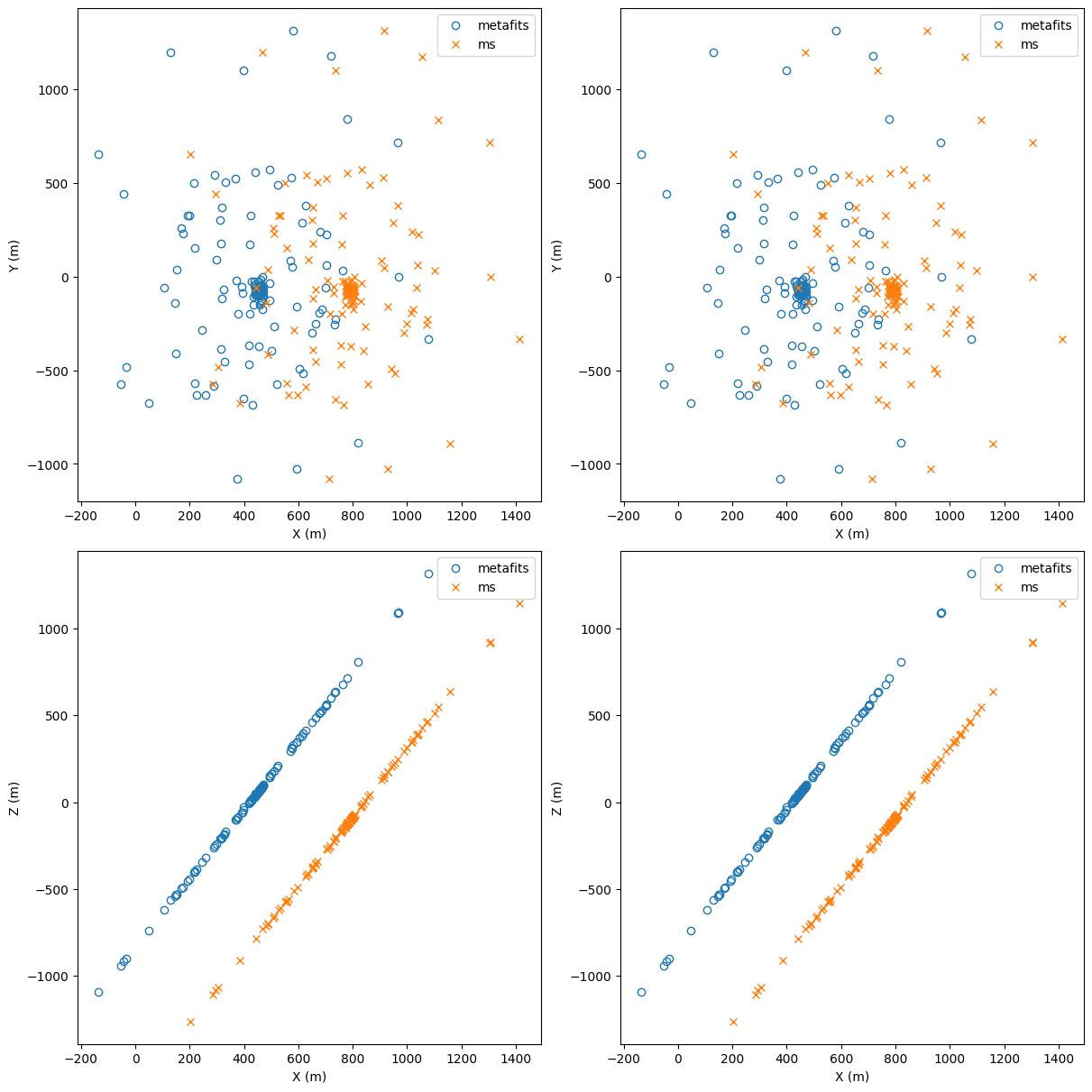
Ah bummer there is some kind of central positional shift in the XYZs. It is unclear if this is a WODEN or a hyperdrive issue. The layouts are exactly the same, just offset.
np.allclose(xyz_meta, xyz_ms, atol=1e-3, rtol=1e-6)
False
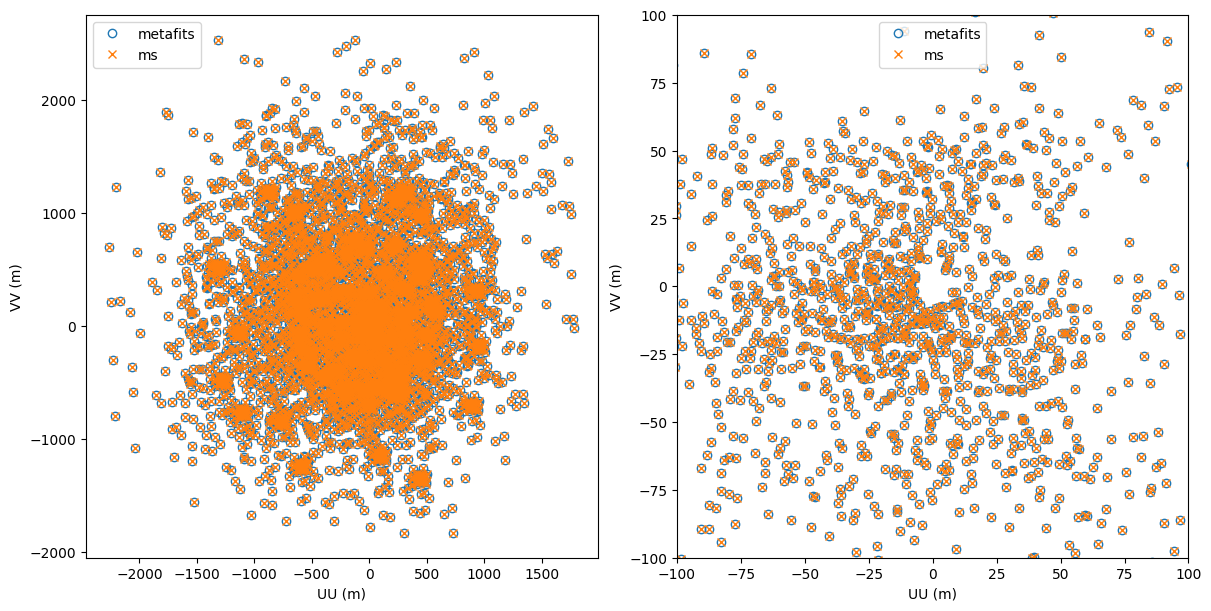
Now compare the uv coords.
fig, axs = plt.subplots(1, 2, figsize=(12, 6), layout='constrained')


for ax in axs:

    ax.plot(uu_meta, vv_meta, 'C0o', mfc='none', label='metafits')
    # ax.plot(-uu_meta, -vv_meta, 'C0o', mfc='none')

    ax.plot(uu_ms, vv_ms, 'C1x', mfc='none', label='ms')
    # ax.plot(-uu_ms, -vv_ms, 'C1x', mfc='none')

    ax.set_xlabel('UU (m)')
    ax.set_ylabel('VV (m)')

    ax.legend()

axs[1].set_xlim(-100, 100)
axs[1].set_ylim(-100, 100)

plt.show()
print(f"u coords max, mean diff {np.max(np.abs(uu_meta - uu_ms)):.2e}, {np.mean(np.abs(uu_meta - uu_ms)):.2e} (metres)")
print(f"v coords max, mean diff {np.max(np.abs(vv_meta - vv_ms)):.2e}, {np.mean(np.abs(vv_meta - vv_ms)):.2e} (metres)")
print(f"w coords max, mean diff {np.max(np.abs(ww_meta - ww_ms)):.2e}, {np.mean(np.abs(ww_meta - ww_ms)):.2e} (metres)")
u coords max, mean diff 8.79e-03, 3.11e-04 (metres)
v coords max, mean diff 8.01e-03, 2.91e-04 (metres)
w coords max, mean diff 2.32e-03, 9.60e-05 (metres)
The layout might be shifted, but the layout is pretty much indentical, as we end up with the same uv coordinates. So that’s good.
Test source positions
With the array offset seen, we need to check that the source positions are still coming out correctly. Make a simulation with a grid of sources, and check that the source positions are coming out correctly.
nside=5
half_width = 5

ra0 = 60.0
dec0 = -30.0

ras = np.linspace(ra0 - half_width, ra0 + half_width, nside)
decs = np.linspace(dec0 - half_width, dec0 + half_width, nside)

ras, decs = np.meshgrid(ras, decs)
ras, decs = ras.flatten(), decs.flatten()

num_comps = len(ras)

ras = ras.flatten()
decs = decs.flatten()

c_ids = Column(data=np.array(['source']*num_comps), name='UNQ_SOURCE_ID', dtype='|S20')
c_names = Column(data=np.array([f'source_C{i:04d}' for i in range(num_comps)]), name='NAME', dtype='|S20')

##Component position
c_ras = Column(data=ras, name='RA')
c_decs = Column(data=decs, name='DEC')

##This says we have a point source
c_comp_types = Column(data=np.array(['P']*num_comps, dtype='|S1'), name="COMP_TYPE", dtype='|S1')
##This says we have a Stokes I power-law SED
c_mod_types = Column(data=np.array(['pl']*num_comps, dtype='|S3'), name="MOD_TYPE", dtype='|S3')

##Set everything as a flat spectrum 1 Jy stokes I source. That way we can image it and see the beam pattern
c_stokes_I_ref = Column(data=np.ones(num_comps), name='NORM_COMP_PL')
c_stokes_I_SI = Column(data=np.zeros(num_comps), name='ALPHA_PL')


cols = [c_ids, c_names, c_ras, c_decs, c_comp_types, c_mod_types, c_stokes_I_ref, c_stokes_I_SI]

main_table = Table(cols)

cat_name = 'check_positions.fits'

main_table.write(cat_name, format='fits', overwrite=True)
primary_beam = "everybeam_MWA"

uvfits_name = f"check_positions_{primary_beam}"
cat_name = 'check_positions.fits'

ms_path = '/mnt/c/Users/jackl/Dropbox/work/test_WODEN/everybeam/run_MWA_beam/hypcal_1125949472.ms'

num_freq_chans = 10
freq_reso = 100e+3
low_freq = 150e+6

ra0 = 60.0
dec0 = -30.0

args = []

args.append(f'--ra0={ra0}')
args.append(f'--dec0={dec0}')
args.append(f'--metafits_filename=1125949472_metafits.fits')
args.append(f'--output_uvfits_prepend={uvfits_name}')
args.append(f'--primary_beam={primary_beam}')
args.append(f'--beam_ms_path={ms_path}')
args.append(f'--freq_res={freq_reso}')
args.append(f'--band_nums=1')
args.append(f'--num_time_steps=5')
args.append(f'--IAU_order')
args.append(f'--station_id=0')
args.append(f'--cat_filename={cat_name}')
args.append(f'--lowest_channel_freq={low_freq}')
args.append(f'--num_freq_channels={num_freq_chans}')
args.append(f'--time_res=2')

run_woden(args)
Successful readonly open of default-locked table /mnt/c/Users/jackl/Dropbox/work/test_WODEN/everybeam/run_MWA_beam/hypcal_1125949472.ms/ANTENNA: 13 columns, 128 rows
You are using WODEN commit: No git describe nor __version__ avaible
LOADING IN /home/jline/software/WODEN_dev/wodenpy/libwoden_double.so
Setting phase centre RA,DEC 60.00000deg -30.00000deg
Obs epoch initial LST was 42.2620215148 deg
Setting initial J2000 LST to 42.0911874758 deg
Setting initial mjd to 57275.8224074073
After precession initial latitude of the array is -26.7665041369 deg
We are precessing the array
Doing the initial reading/mapping of sky model into chunks
INFO: couldn't find second table containing shapelet information, so not attempting to load any shapelets.
Mapping took 0.0 mins
Have read in 25 components
After cropping there are 25 components
From Set 0 thread num 0 reading 4 points, 0 gauss, 0 shape, 0 shape coeffs using thread id 0From Set 0 thread num 2 reading 4 points, 0 gauss, 0 shape, 0 shape coeffs using thread id 2From Set 0 thread num 1 reading 4 points, 0 gauss, 0 shape, 0 shape coeffs using thread id 1From Set 0 thread num 4 reading 4 points, 0 gauss, 0 shape, 0 shape coeffs using thread id 4From Set 0 thread num 3 reading 4 points, 0 gauss, 0 shape, 0 shape coeffs using thread id 3


From Set 0 thread num 6 reading 1 points, 0 gauss, 0 shape, 0 shape coeffs using thread id 6From Set 0 thread num 5 reading 4 points, 0 gauss, 0 shape, 0 shape coeffs using thread id 5
From Set 0 thread num 7 reading 0 points, 0 gauss, 0 shape, 0 shape coeffs using thread id 7


Thread 7 has no work to do
Finshed thread 6 in 7.6 seconds
Finshed thread 1 in 26.9 seconds
Finshed thread 4 in 27.2 seconds
Finshed thread 2 in 27.2 secondsFinshed thread 5 in 27.2 seconds

Finshed thread 0 in 27.3 seconds
Finshed thread 3 in 27.3 seconds
Sending set 0 to GPU
Set 0 has returned from the GPU after 0.5 seconds
cmd = "woden_uv2ms.py "
cmd += "  --uvfits_prepend=check_positions_everybeam_MWA_band "
cmd += "  --band_nums=1  "

call(cmd, shell=True)

cmd = "wsclean -name check_positions_everybeam_MWA -size 2048 2048 -niter 2000 "
cmd += "  -auto-threshold 0.5 -auto-mask 3 "
cmd += "  -pol I -multiscale -weight briggs 0 -scale 0.01 -j 12 -mgain 0.85 "
cmd += "  -no-update-model-required "
cmd += "  check_positions_everybeam_MWA_band*.ms "

##something is cooked with my local wsclean installation, so I have to call
##this on the command line, hence just printing here
print(cmd)
# call(cmd, shell=True)
/home/jline/software/anaconda3/envs/woden_dev/bin/woden_uv2ms.py:4: DeprecationWarning: pkg_resources is deprecated as an API. See https://setuptools.pypa.io/en/latest/pkg_resources.html
  __import__('pkg_resources').require('wodenpy==2.3.0')
The telescope frame is set to '????', which generally indicates ignorance. Defaulting the frame to 'itrs', but this may lead to other warnings or errors.
Writing in the MS file that the units of the data are uncalib, although some CASA process will ignore this and assume the units are all in Jy (or may not know how to handle data in these units).
wsclean -name check_positions_everybeam_MWA -size 2048 2048 -niter 2000 -auto-threshold 0.5 -auto-mask 3 -pol I -multiscale -weight briggs 0 -scale 0.01 -j 12 -mgain 0.85 -no-update-model-required check_positions_everybeam_MWA_band*.ms
with fits.open('check_positions_everybeam_MWA-image.fits') as hdu:
    image = np.squeeze(hdu[0].data)
    wcs = WCS(hdu[0].header).celestial

fig, axs = plt.subplots(1, 1, figsize=(12, 8), subplot_kw={'projection': wcs})

im = axs.imshow(image, origin='lower', cmap='Blues_r')#, vmin=0, vmax=1.0)
plt.colorbar(im, ax=axs, label='Jy/beam')

# half_width = 600

# axs.set_xlim(1024-half_width, 1024+half_width)
# axs.set_ylim(1024-half_width, 1024+half_width)

plt.grid(alpha=0.5)

plt.show()
WARNING: FITSFixedWarning: 'datfix' made the change 'Set MJD-OBS to 57275.822406 from DATE-OBS'. [astropy.wcs.wcs]
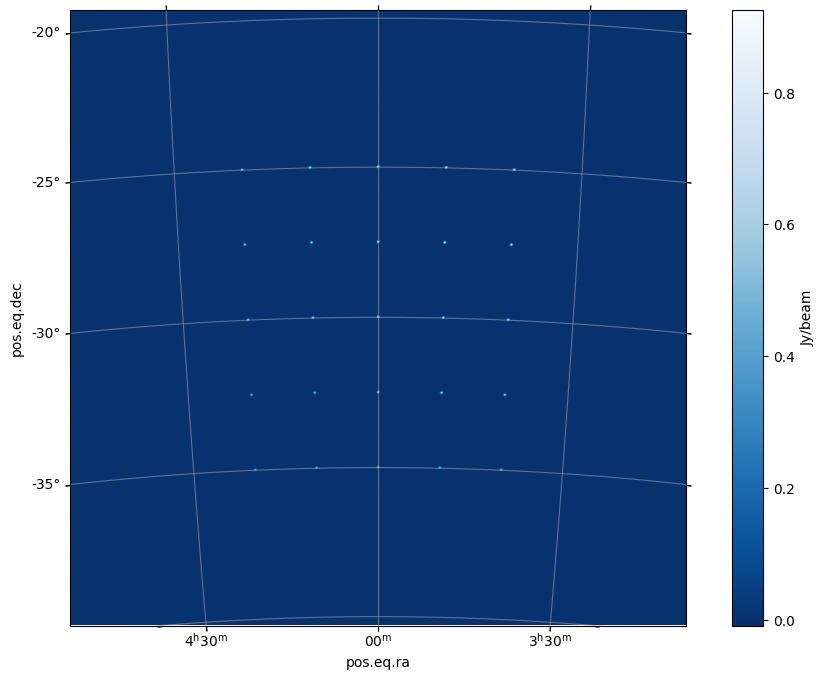
Everything seems to be in the correct RA/Dec position, so that’s schweet.
Try off zenith pointings
Now we’ll test whether we can do off-zenith pointings. We’ll also test that we can run multiple time steps and frequencies. The measurement set I’m using is real calibrated data from the MWA. Unfortunately, it’s 2GB, so there’s no good way to include that with the WODEN repo. If you want to run this test, you should be able to get some data from the MWA ASVO https://asvo.mwatelescope.org/, and then convert that into a measurement set using pyuvdata for example.
ra0 = 60.0
dec0 = -30.0
date = "2015-09-10T19:44:15"
observing_time = Time(date, scale='utc', location=mwa_location)

##Setup a grid of RA/Dec on the sky
nside=50
radec_reso = 120/nside

header, wcs = create_WCS(ra0, dec0, nside, radec_reso)
x_mesh, y_mesh = np.meshgrid(np.arange(nside), np.arange(nside))
ras, decs = wcs.all_pix2world(x_mesh, y_mesh, 0)

ras = np.radians(ras.flatten())
decs = np.radians(decs.flatten())

num_comps = len(ras)

##Do a single freqs and time and beam
all_freqs = np.array([100e+6, 200e+6])
all_times = np.array([observing_time, observing_time + TimeDelta(2*3600.0, format='sec')])
num_beams = 1
station_ids = [0]

lsts = []
latitudes = []

for obs_time in all_times:

    LST = obs_time.sidereal_time('mean')
    lst_current = np.radians(LST.value*15)

    lst_J2000, latitude_J2000 = RTS_Precess_LST_Lat_to_J2000(
                                lst_current,
                                np.radians(MWA_LAT),
                                obs_time.mjd)

    lsts.append(lst_J2000)
    latitudes.append(latitude_J2000)

coeff_path="/home/jline/software/MWA_beam_files/mwa_full_embedded_element_pattern.h5"
ms_path = '/mnt/c/Users/jackl/Dropbox/work/test_WODEN/everybeam/run_MWA_beam/hypcal_1125949472.ms'

use_differential_beam=False
apply_beam_norms = False
reorder_jones = True
parallactic_rotate = True

num_threads = 8

all_jones = run_everybeam_over_threads(num_threads, ms_path,
                            coeff_path,
                            ras, decs,
                            np.radians(ra0), np.radians(dec0),
                            latitudes, lsts,
                            np.radians(MWA_LAT), np.radians(MWA_LONG),
                            all_times, all_freqs, station_ids,
                            use_differential_beam=use_differential_beam,
                            apply_beam_norms=apply_beam_norms,
                            reorder_jones=reorder_jones,
                            parallactic_rotate=parallactic_rotate)
Thread 0 processing coords 0 to 313Thread 3 processing coords 939 to 1252Thread 4 processing coords 1252 to 1565Thread 6 processing coords 1878 to 2191Thread 1 processing coords 313 to 626Thread 2 processing coords 626 to 939Thread 5 processing coords 1565 to 1878
/home/jline/software/anaconda3/envs/woden_dev/lib/python3.12/site-packages/erfa/core.py:18110: RuntimeWarning: invalid value encountered in hd2ae
  az, el = ufunc.hd2ae(ha, dec, phi)
/home/jline/software/anaconda3/envs/woden_dev/lib/python3.12/site-packages/erfa/core.py:18110: RuntimeWarning: invalid value encountered in hd2ae
  az, el = ufunc.hd2ae(ha, dec, phi)
/home/jline/software/anaconda3/envs/woden_dev/lib/python3.12/site-packages/erfa/core.py:18110: RuntimeWarning: invalid value encountered in hd2ae
  az, el = ufunc.hd2ae(ha, dec, phi)
/home/jline/software/anaconda3/envs/woden_dev/lib/python3.12/site-packages/erfa/core.py:18110: RuntimeWarning: invalid value encountered in hd2ae
  az, el = ufunc.hd2ae(ha, dec, phi)
/home/jline/software/anaconda3/envs/woden_dev/lib/python3.12/site-packages/erfa/core.py:18110: RuntimeWarning: invalid value encountered in hd2ae
  az, el = ufunc.hd2ae(ha, dec, phi)
/home/jline/software/anaconda3/envs/woden_dev/lib/python3.12/site-packages/erfa/core.py:18110: RuntimeWarning: invalid value encountered in hd2ae
  az, el = ufunc.hd2ae(ha, dec, phi)
/home/jline/software/anaconda3/envs/woden_dev/lib/python3.12/site-packages/erfa/core.py:18110: RuntimeWarning: invalid value encountered in hd2ae
  az, el = ufunc.hd2ae(ha, dec, phi)
Thread 7 processing coords 2191 to 2504
/home/jline/software/anaconda3/envs/woden_dev/lib/python3.12/site-packages/erfa/core.py:18110: RuntimeWarning: invalid value encountered in hd2ae
  az, el = ufunc.hd2ae(ha, dec, phi)
Thread 7 finished
Thread 2 finished
Thread 3 finished
Thread 5 finished
Thread 6 finished
Thread 0 finished
Thread 4 finished
Thread 1 finished
beam_ind = 0

for time_ind in range(len(all_times)):
    for freq_ind in range(len(all_freqs)):
        this_gx = all_jones[beam_ind, time_ind, freq_ind, :, 0, 0]
        this_Dx = all_jones[beam_ind, time_ind, freq_ind, :, 0, 1]
        this_Dy = all_jones[beam_ind, time_ind, freq_ind, :, 1, 0]
        this_gy = all_jones[beam_ind, time_ind, freq_ind, :, 1, 1]

        this_gx.shape = (nside, nside)
        this_Dx.shape = (nside, nside)
        this_Dy.shape = (nside, nside)
        this_gy.shape = (nside, nside)

        plot_jones_on_sky(this_gx, this_Dx, this_Dy, this_gy, wcs, title="everybeam with parallactic rotation")
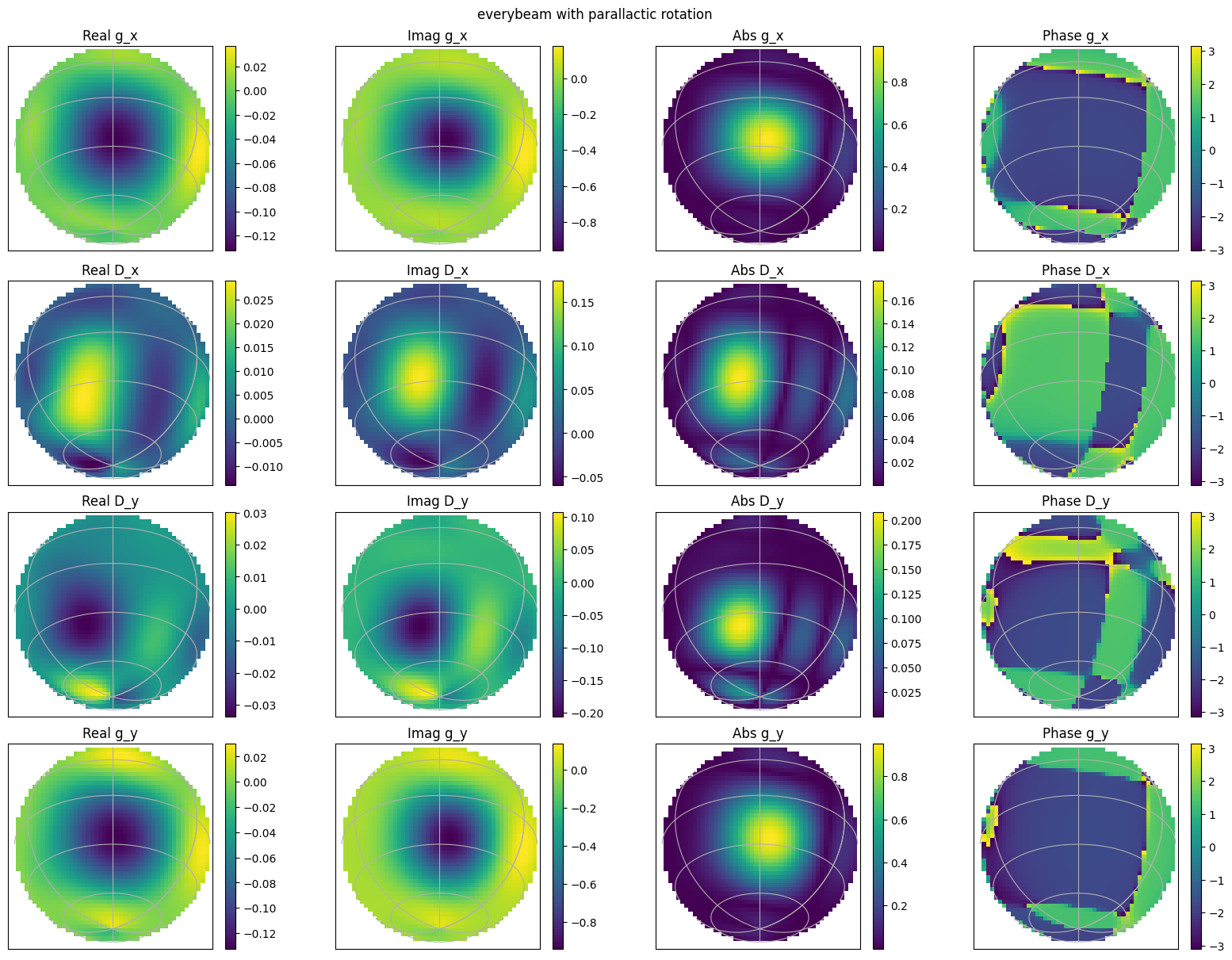
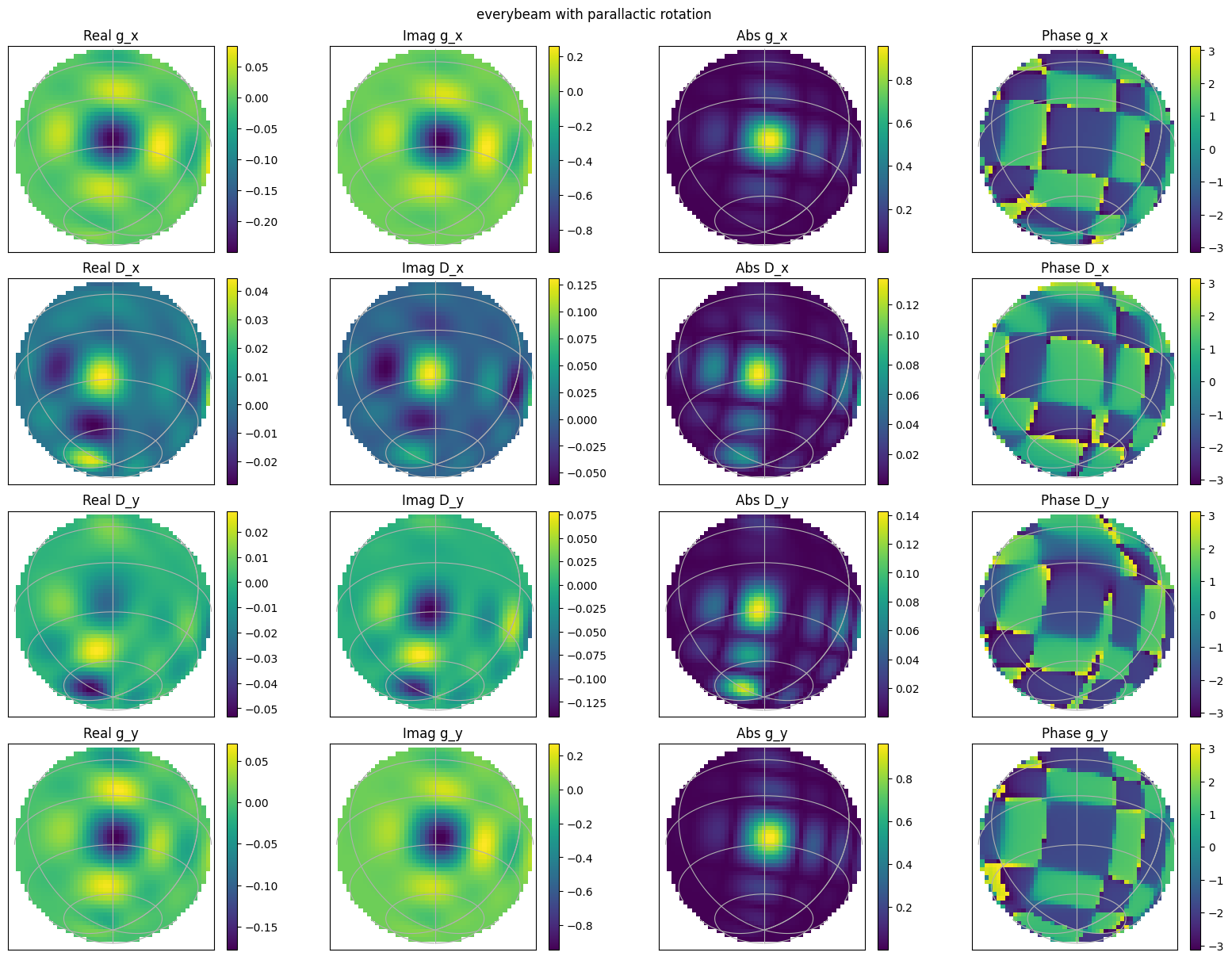
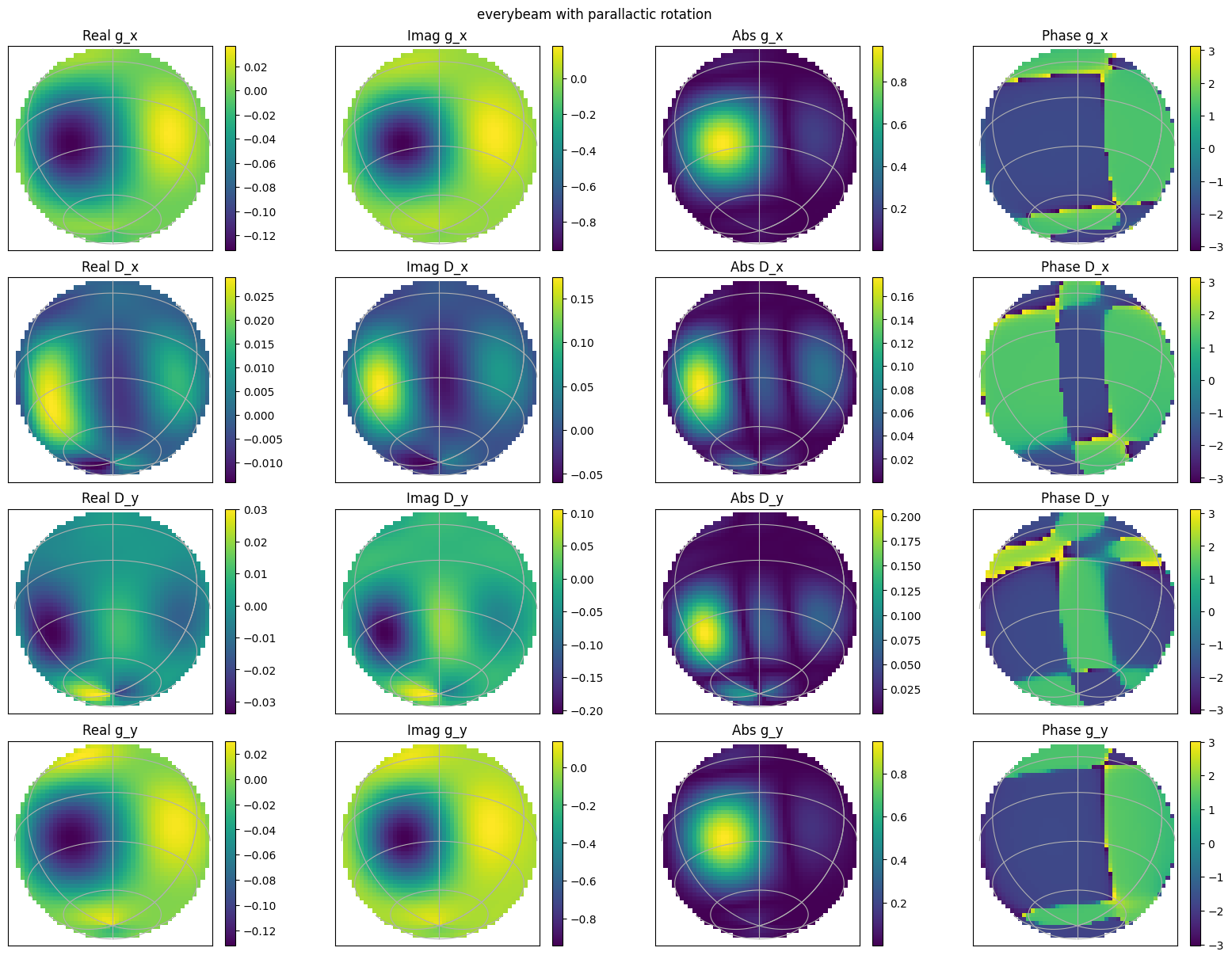
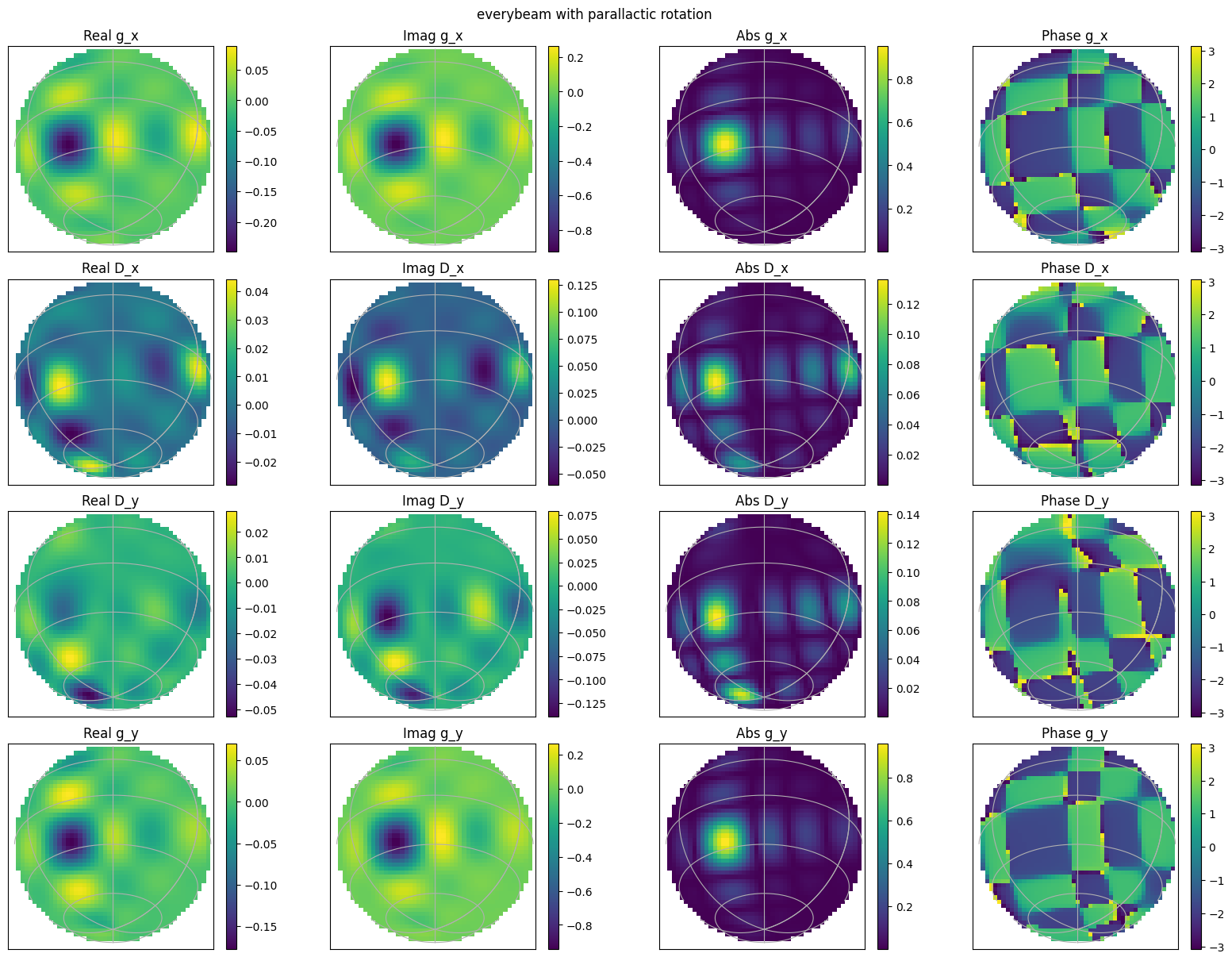
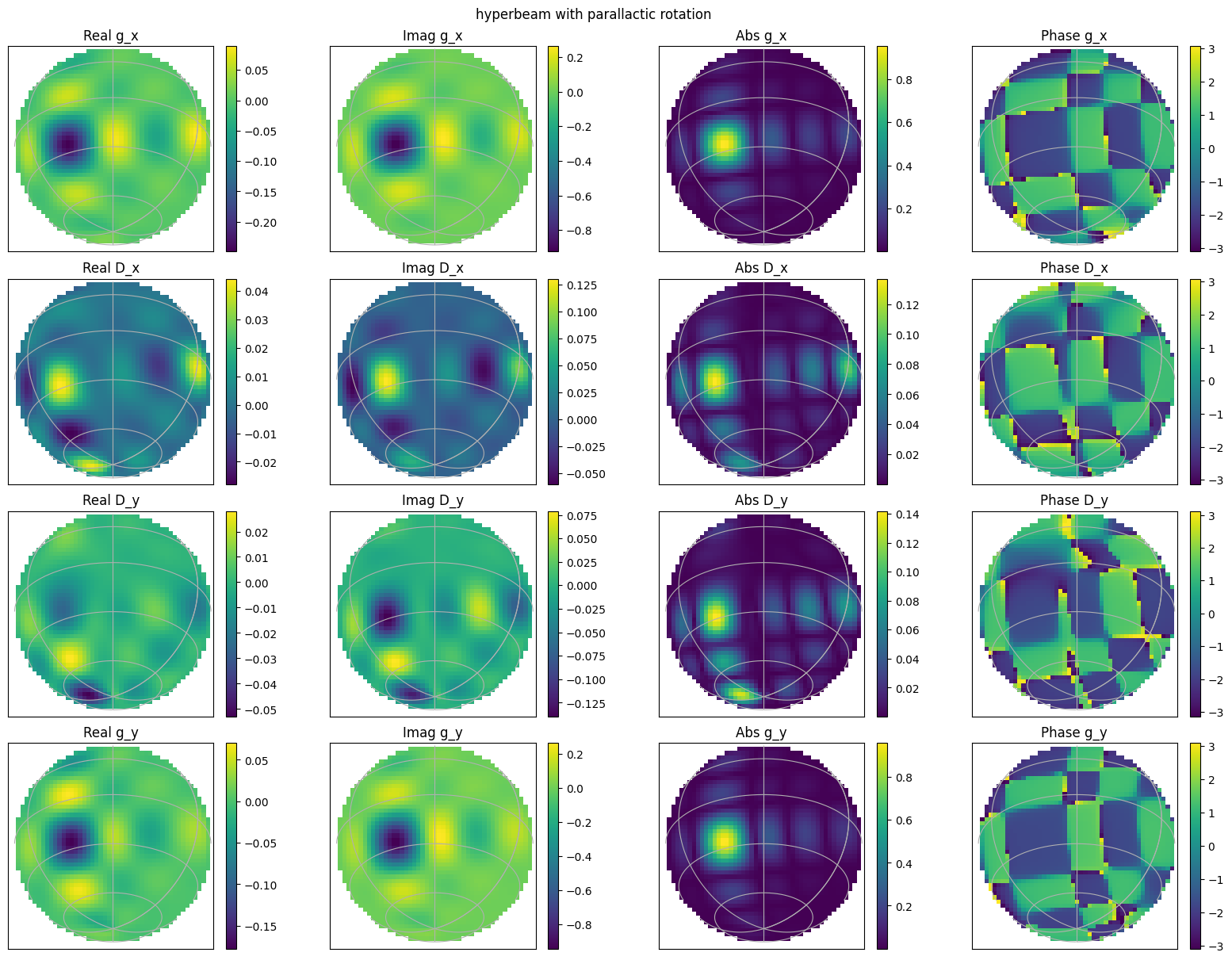
Double check what it should look like using hyperdrive, where we can explicitly put the delays that we want in.
##use this erfa function to convert to azimuth and elevation
##were using degrees, but erfa uses rads, so convert here

for this_time in all_times:
    for freq in all_freqs:

        has = np.radians(this_time.sidereal_time('mean').value*15.0) - ras

        az_grid, els = erfa.hd2ae(has, decs, np.radians(MWA_LAT))

        za_grid = np.pi/2 - els

        beam = mwa_hyperbeam.FEEBeam()

        parallactic_rotation = True
        delays = [0,2,4,6,0,2,4,6,0,2,4,6,0,2,4,6]

        jones = beam.calc_jones_array(az_grid, za_grid, freq, delays, [1]*16, True, np.radians(MWA_LAT), parallactic_rotation)

        all_gx = jones[:,0]
        all_Dx = jones[:,1]
        all_Dy = jones[:,2]
        all_gy = jones[:,3]

        all_gx.shape = (nside, nside)
        all_Dx.shape = (nside, nside)
        all_Dy.shape = (nside, nside)
        all_gy.shape = (nside, nside)

        plot_jones_on_sky(all_gx, all_Dx, all_Dy, all_gy, wcs, title="hyperbeam with parallactic rotation")
/home/jline/software/anaconda3/envs/woden_dev/lib/python3.12/site-packages/erfa/core.py:18110: RuntimeWarning: invalid value encountered in hd2ae
  az, el = ufunc.hd2ae(ha, dec, phi)
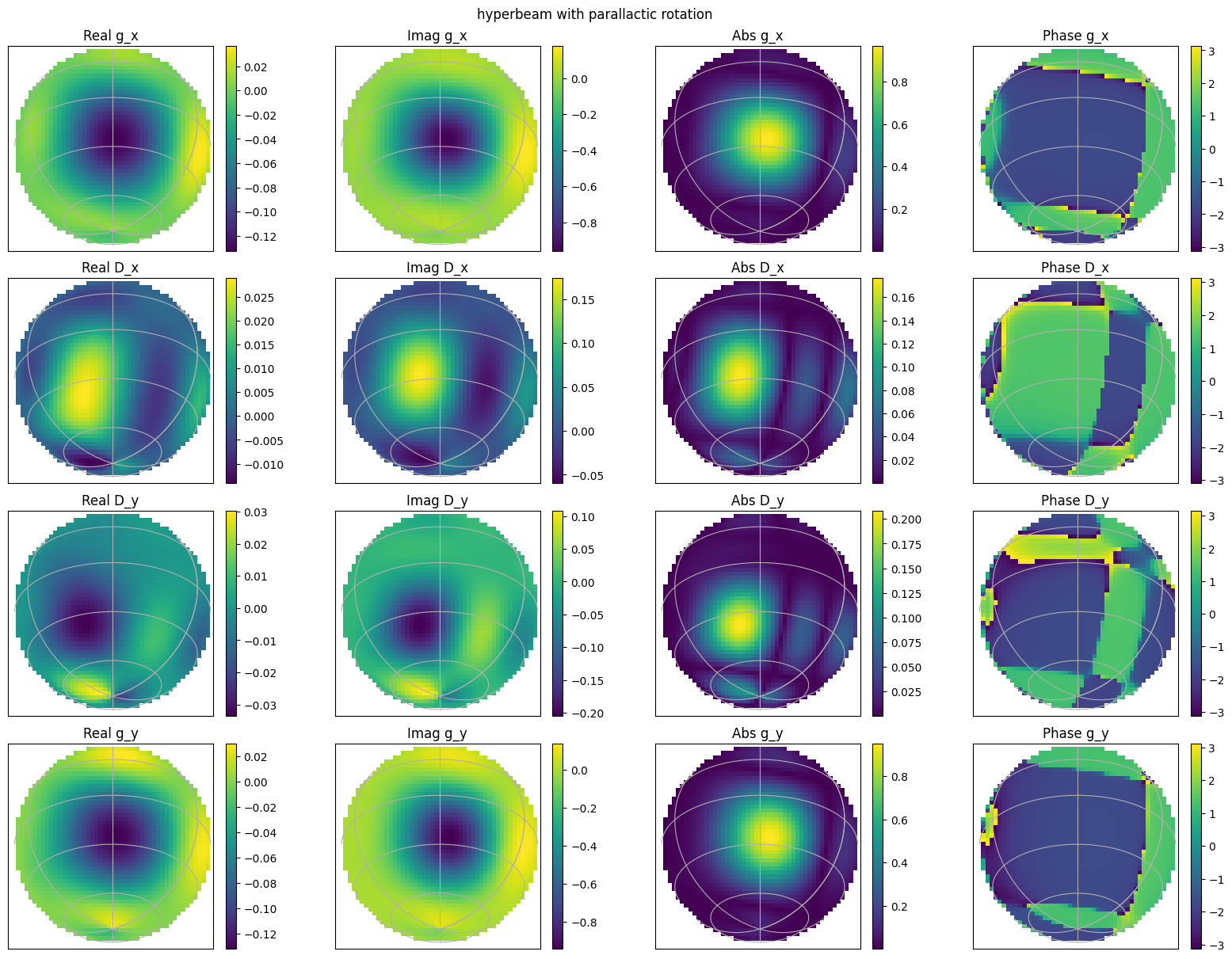
/home/jline/software/anaconda3/envs/woden_dev/lib/python3.12/site-packages/erfa/core.py:18110: RuntimeWarning: invalid value encountered in hd2ae
  az, el = ufunc.hd2ae(ha, dec, phi)
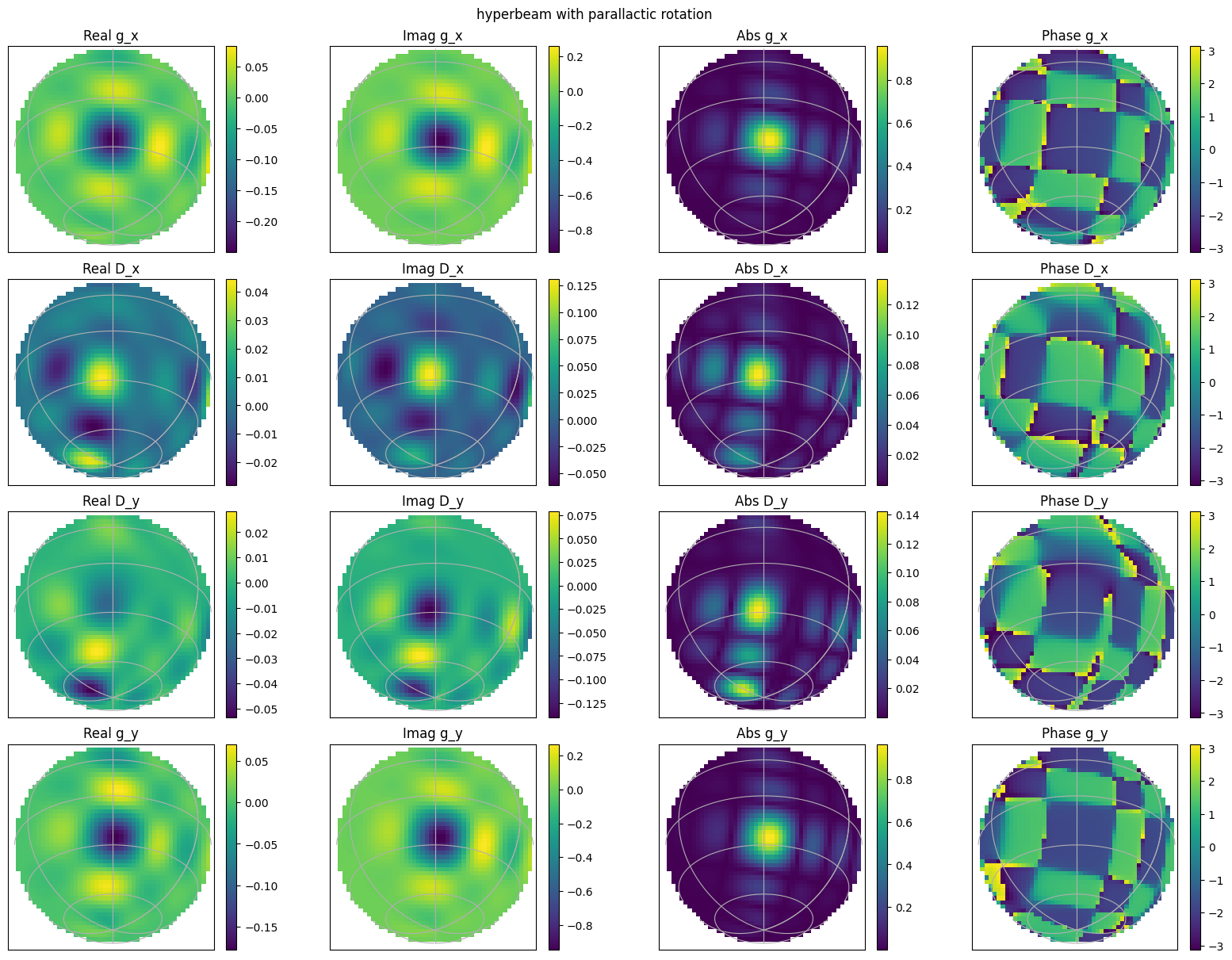
/home/jline/software/anaconda3/envs/woden_dev/lib/python3.12/site-packages/erfa/core.py:18110: RuntimeWarning: invalid value encountered in hd2ae
  az, el = ufunc.hd2ae(ha, dec, phi)
/home/jline/software/anaconda3/envs/woden_dev/lib/python3.12/site-packages/erfa/core.py:18110: RuntimeWarning: invalid value encountered in hd2ae
  az, el = ufunc.hd2ae(ha, dec, phi)
Profiling the code
Here we’ll profile the code to see where the bottlenecks are. We’ll use the line_profiler module.
Now make a sky model with an array of ra, decs so we can check the profiled outputs make sense, and also that the MWA beam is manifesting correctly. We’ll run WODEN on the command line, setting LINE_PROFILE=1 to ensure the main funciton gets profiled. We’ll also add the --profile flag to run_woden.py. This is because WODEN run mulitple threads to speed up EveryBeam calls, and profilers struggle with threading. Internal to WODEN, we’ll launch the line_profiler for every sky model thread, meaning we dump a bunch of reports.
Right, make the sky model here.
nside=15
radec_reso = 30/nside

ra0 = 0
dec0=-26.7

header, wcs = create_WCS(ra0, dec0, nside, radec_reso)
x_mesh, y_mesh = np.meshgrid(np.arange(nside), np.arange(nside))
ras, decs = wcs.all_pix2world(x_mesh, y_mesh, 0)

ras = ras.flatten()
decs = decs.flatten()

num_comps = len(ras)

c_ids = Column(data=np.array(['source']*num_comps), name='UNQ_SOURCE_ID', dtype='|S20')
c_names = Column(data=np.array([f'source_C{i:04d}' for i in range(num_comps)]), name='NAME', dtype='|S20')

##Component position
c_ras = Column(data=ras, name='RA')
c_decs = Column(data=decs, name='DEC')

##This says we have a point source
c_comp_types = Column(data=np.array(['P']*num_comps, dtype='|S1'), name="COMP_TYPE", dtype='|S1')
##This says we have a Stokes I power-law SED
c_mod_types = Column(data=np.array(['pl']*num_comps, dtype='|S3'), name="MOD_TYPE", dtype='|S3')

##Set everything as a flat spectrum 1 Jy stokes I source. That way we can image it and see the beam pattern
c_stokes_I_ref = Column(data=np.ones(num_comps), name='NORM_COMP_PL')
c_stokes_I_SI = Column(data=np.zeros(num_comps), name='ALPHA_PL')


cols = [c_ids, c_names, c_ras, c_decs, c_comp_types, c_mod_types, c_stokes_I_ref, c_stokes_I_SI]

main_table = Table(cols)

profile_cat = 'profiling_source.fits'

main_table.write(profile_cat, format='fits', overwrite=True)
Now make a WODEN command to profile, and launch it.
ra0=0.0
dec0=-26.7
date="2024-07-21T20:13:00"
profile_cat="profiling_source.fits"
primary_beam="everybeam_MWA"
num_times=5
num_freq_chans=10
low_freq=160e+6
ms_path="MWA-single-timeslot.ms"
uvfits_name="profile_run_woden"
freq_reso=80e+3

command = "LINE_PROFILE=1 run_woden.py "

command += f'--ra0={ra0} '
command += f'--dec0={dec0} '
command += f'--date={date} '
command += f'--output_uvfits_prepend={uvfits_name} '
command += f'--primary_beam={primary_beam} '
command += f'--beam_ms_path={ms_path} '
command += f'--freq_res={freq_reso} '
command += f'--band_nums=1 '
command += f'--num_time_steps={num_times} '
command += f'--IAU_order '
command += f'--station_id=0 '
command += f'--cat_filename={profile_cat} '
command += f'--lowest_channel_freq={low_freq} '
command += f'--num_freq_channels={num_freq_chans} '
command += f'--time_res=2 '
command += f'--num_threads=8 '
command += f'--profile '

##Delete previous results before running
call('rm *.lprof', shell=True)
call(command, shell=True)
/home/jline/software/anaconda3/envs/woden_dev/bin/run_woden.py:4: DeprecationWarning: pkg_resources is deprecated as an API. See https://setuptools.pypa.io/en/latest/pkg_resources.html
  __import__('pkg_resources').require('wodenpy==2.3.0')
Successful readonly open of default-locked table MWA-single-timeslot.ms/ANTENNA: 8 columns, 128 rows
You are using WODEN commit: No git describe nor __version__ avaible
LOADING IN /home/jline/software/WODEN_dev/wodenpy/libwoden_double.so
Setting phase centre RA,DEC 0.00000deg -26.70000deg
Obs epoch initial LST was 0.0087300922 deg
Setting initial J2000 LST to 359.6931723607 deg
Setting initial mjd to 60512.8423726853
After precession initial latitude of the array is -26.8398178265 deg
We are precessing the array
Doing the initial reading/mapping of sky model into chunks
INFO: couldn't find second table containing shapelet information, so not attempting to load any shapelets.
Mapping took 0.0 mins
Have read in 225 components
After cropping there are 225 components
From Set 0 thread num 0 reading 29 points, 0 gauss, 0 shape, 0 shape coeffs using thread id 0
From Set 0 thread num 2 reading 29 points, 0 gauss, 0 shape, 0 shape coeffs using thread id 2From Set 0 thread num 1 reading 29 points, 0 gauss, 0 shape, 0 shape coeffs using thread id 1

From Set 0 thread num 3 reading 29 points, 0 gauss, 0 shape, 0 shape coeffs using thread id 3
From Set 0 thread num 4 reading 29 points, 0 gauss, 0 shape, 0 shape coeffs using thread id 4
From Set 0 thread num 5 reading 29 points, 0 gauss, 0 shape, 0 shape coeffs using thread id 5
From Set 0 thread num 6 reading 29 points, 0 gauss, 0 shape, 0 shape coeffs using thread id 6
From Set 0 thread num 7 reading 22 points, 0 gauss, 0 shape, 0 shape coeffs using thread id 7
Finshed thread 7 in 217.8 seconds
Dumping profile to line_profile_64725.lprof
Finshed thread 2 in 274.0 seconds
Dumping profile to line_profile_64720.lprof
Finshed thread 1 in 275.0 seconds
Dumping profile to line_profile_64719.lprof
Finshed thread 6 in 275.2 seconds
Dumping profile to line_profile_64724.lprof
Finshed thread 3 in 276.6 seconds
Dumping profile to line_profile_64721.lprof
Finshed thread 0 in 276.8 seconds
Dumping profile to line_profile_64718.lprof
Finshed thread 5 in 277.0 seconds
Dumping profile to line_profile_64723.lprof
Finshed thread 4 in 277.1 seconds
Dumping profile to line_profile_64722.lprof
Sending set 0 to GPU
Set 0 has returned from the GPU after 1.0 seconds
Timer unit: 1e-09 s

281.44 seconds - /home/jline/software/WODEN_dev/scripts/run_woden.py:242 - main
Wrote profile results to profile_output.txt
Wrote profile results to profile_output_2024-11-11T150730.txt
Wrote profile results to profile_output.lprof
To view details run:
python -m line_profiler -rtmz profile_output.lprof
0
OK, the main function will be profiled with the results written to profile_output.txt. We’ll also get a bunch of *.lprof files for each of the sky model / beam calculation threads, which we can read in with line_profiler to see what’s going on. First up, let’s look at some specific lines from profile_output.txt. The part below shows where the sky model/beam calculation code, as well as the GPU code, is run:
Line #      Hits         Time  Per Hit   % Time  Line Contents
==============================================================
353         1      27432.0  27432.0      0.0              gpu_executor = concurrent.futures.ThreadPoolExecutor(max_workers=1)
354         1        341.0    341.0      0.0              gpu_calc = None  # To store the future of the calculation thread
355
356                                                       # Loop through multiple rounds of data reading and calculation
357         2       2485.0   1242.5      0.0              for round_num in range(num_rounds):
358        25   49810705.0    2e+06      0.0                  future_data = [executor.submit(read_skymodel_thread, i + round_num * num_threads,
359         8       6514.0    814.2      0.0                                                 num_threads, chunked_skymodel_map_sets,
360         8       5559.0    694.9      0.0                                                 lsts, latitudes,
361         8       5080.0    635.0      0.0                                                 args,
362         8      15790.0   1973.8      0.0                                                 woden_settings.beamtype,
363         8       6105.0    763.1      0.0                                                 main_table, shape_table,
364         8       1743.0    217.9      0.0                                                 v_table, q_table, u_table, p_table)
365         9       2786.0    309.6      0.0                                 for i in range(num_threads)]
366
367         1       6653.0   6653.0      0.0                  all_loaded_python_sources = []
368         1        301.0    301.0      0.0                  all_loaded_sources_orders = []
369         9        3e+11    3e+10     98.5                  for future in concurrent.futures.as_completed(future_data):
370         8     171885.0  21485.6      0.0                      python_sources, order = future.result()
371         8      10681.0   1335.1      0.0                      all_loaded_python_sources.append(python_sources)
372         8       9549.0   1193.6      0.0                      all_loaded_sources_orders.append(order)
373
374                                                           # Wait for previous calculation to complete (if there was one)
375         1        621.0    621.0      0.0                  if gpu_calc is not None:
376                                                               meh = gpu_calc.result()
377
378         2    5909958.0    3e+06      0.0                  gpu_calc = gpu_executor.submit(woden_thread,
379         1        210.0    210.0      0.0                                                 all_loaded_python_sources,
380         1        161.0    161.0      0.0                                                 all_loaded_sources_orders,
381         1        331.0    331.0      0.0                                                 round_num,
382         1       4869.0   4869.0      0.0                                                 run_woden, woden_settings,
383         1       3075.0   3075.0      0.0                                                 visi_set_array, array_layout,
384         1       1433.0   1433.0      0.0                                                 woden_struct_classes, sbf,
385         1       3566.0   3566.0      0.0                                                 woden_settings.beamtype,
386         1       3937.0   3937.0      0.0                                                 args.precision)
387
388                                                       # # Wait for the final calculation to complete
389         1        291.0    291.0      0.0              if gpu_calc is not None:
390         1 1026352569.0    1e+09      0.4                  meh = gpu_calc.result()
281.44 seconds - /home/jline/software/WODEN_dev/scripts/run_woden.py:242 - main
Specifically, these lines:
    Line #      Hits         Time  Per Hit   % Time  Line Contents
==============================================================
   369         9        3e+11    3e+10     98.5                  for future in concurrent.futures.as_completed(future_data):
   390         1 1026352569.0    1e+09      0.4                  meh = gpu_calc.result()
show that 98.5% of the entire time is spent gathering results from sky model/beam calculation code, and 0.4% is doing GPU calculations.
However, this doesn’t tell us whether the sky model reading is slow, or the EveryBeam code calls are. For that, we have to look at the line_profile_*.lprof files, which are output by each thread. We’ll look at the entirety of the first one here:
from glob import glob
from line_profiler.line_profiler import load_stats, show_text
import line_profiler

files = glob("line_profile_*.lprof")

stats = load_stats(files[0])
show_text(stats.timings, stats.unit)
Timer unit: 1e-09 s
Total time: 276.51 s
File: /home/jline/software/WODEN_dev/wodenpy/primary_beam/use_everybeam.py
Function: run_everybeam at line 221
Line # Hits Time Per Hit % Time Line Contents
==============================================================
221 def run_everybeam(ras : np.ndarray, decs : np.ndarray,
222 beam_ra0 : float, beam_dec0 : float,
223 j2000_latitudes : np.ndarray, j2000_lsts : np.ndarray,
224 current_latitude : float, current_longitude : float,
225 times : np.ndarray, freqs : np.ndarray,
226 telescope: eb.Telescope, # type: ignore
227 station_ids : np.ndarray,
228 apply_beam_norms : bool = True,
229 reorder_jones : bool = False,
230 element_only : bool = False,
231 eb_rotate : bool = False,
232 parallactic_rotate : bool = False,
233 para_angle_offset : float = -np.pi/2) -> np.ndarray:
234
235
236 1 1062.0 1062.0 0.0 num_stations = len(station_ids)
237 1 240.0 240.0 0.0 num_times = len(times)
238 1 932.0 932.0 0.0 num_freqs = len(freqs)
239 1 201.0 201.0 0.0 num_coords = len(ras)
240
241 1 144888.0 144888.0 0.0 all_output_jones = np.zeros((num_stations, num_times, num_freqs, num_coords, 2, 2), dtype=np.complex128)*np.nan
242
243 1 431.0 431.0 0.0 if parallactic_rotate:
244 1 1012.0 1012.0 0.0 if type(telescope) != eb.MWA or type(telescope) != eb.MWALocal:
245 1 7562918.0 8e+06 0.0 coords = SkyCoord(ras*u.rad, decs*u.rad, frame='icrs')
246 2 3322284.0 2e+06 0.0 location = EarthLocation(lat=current_latitude*u.rad,
247 1 35047.0 35047.0 0.0 lon=current_longitude*u.rad)
248
249 6 32112.0 5352.0 0.0 for time_ind, time in enumerate(times):
250
251 5 67751.0 13550.2 0.0 if type(telescope) == eb.MWA or type(telescope) == eb.MWALocal:
252 5 366079.0 73215.8 0.0 comp_has = j2000_lsts[time_ind] - ras
253 5 749039.0 149807.8 0.0 azs, els = erfa.hd2ae(comp_has, decs, j2000_latitudes[time_ind])
254 5 85275.0 17055.0 0.0 zas = np.pi/2 - els
255
256 5 3097.0 619.4 0.0 if parallactic_rotate:
257 5 48023.0 9604.6 0.0 beam_ha0 = j2000_lsts[time_ind] - beam_ra0
258 10 124060.0 12406.0 0.0 beam_az0, beam_el0 = erfa.hd2ae(beam_ha0, beam_dec0,
259 5 2654.0 530.8 0.0 j2000_latitudes[time_ind])
260 5 14648.0 2929.6 0.0 beam_za0 = np.pi/2 - beam_el0
261
262 else:
263 phase_itrf = radec_to_xyz(beam_ra0, beam_dec0, time)
264 dir_itrfs = radec_to_xyz(ras, decs, time)
265
266 if parallactic_rotate:
267 ncp_t = eb_local_xyz_from_radec(0, np.radians(90), altaz_frame)
268 dir_local = eb_local_xyz_from_radec(ras, decs, altaz_frame)
269 altaz_frame = AltAz(obstime=time, location=location)
270
271 5 3014506.0 602901.2 0.0 time_mjd_secs = time.mjd*3600*24
272
273 5 3907.0 781.4 0.0 if parallactic_rotate:
274 5 47872.0 9574.4 0.0 has = j2000_lsts[time_ind] - ras
275 5 99984.0 19996.8 0.0 para_angles = erfa.hd2pa(has, decs, j2000_latitudes[time_ind])
276
277 5 93379.0 18675.8 0.0 rot_matrix = np.empty((num_coords, 2,2))
278
279 5 17043.0 3408.6 0.0 if type(telescope) == eb.MWA or type(telescope) == eb.MWALocal:
280 5 122467.0 24493.4 0.0 rot_matrix[:,0,0] = np.sin(-para_angles)
281 5 53934.0 10786.8 0.0 rot_matrix[:,0,1] = -np.cos(-para_angles)
282 5 22394.0 4478.8 0.0 rot_matrix[:,1,0] = -np.cos(-para_angles)
283 5 22202.0 4440.4 0.0 rot_matrix[:,1,1] = -np.sin(-para_angles)
284
285 else:
286 for dir_ind, dir_itrf in enumerate(dir_itrfs):
287
288 dir_az = dir_local[dir_ind]
289 north, east = eb_north_east(dir_az, ncp_t)
290 rot = calc_everybeam_rotation(dir_az, north, east)
291 rot_matrix[dir_ind] = rot
292
293 10 43065.0 4306.5 0.0 for station_ind, station_id in enumerate(station_ids):
294 55 922612.0 16774.8 0.0 for freq_ind, freq in enumerate(freqs):
295
296 50 125789.0 2515.8 0.0 if apply_beam_norms:
297 if type(telescope) == eb.MWA:
298 ##Get the response
299 norm_jones = telescope.station_response(time_mjd_secs, station_id, freq,
300 beam_ra0, beam_dec0)
301 elif type(telescope) == eb.MWALocal:
302 norm_jones = telescope.station_response(time_mjd_secs, station_id, freq,
303 beam_az0, beam_za0)
304
305 if type(telescope) == eb.MWA or type(telescope) == eb.MWALocal:
306 if parallactic_rotate:
307 ha0 = j2000_lsts[time_ind] - beam_ra0
308 para_angles = erfa.hd2pa(ha0, beam_dec0, j2000_latitudes[time_ind])
309 rot = np.empty((2,2))
310 rot[0,0] = np.sin(-para_angles)
311 rot[0,1] = -np.cos(-para_angles)
312 rot[1,0] = -np.cos(-para_angles)
313 rot[1,1] = -np.sin(-para_angles)
314
315 else:
316 element_id = 0
317 if element_only:
318 norm_jones = telescope.element_response(time_mjd_secs, station_id, element_id, freq,
319 phase_itrf, rotate=eb_rotate)
320 else:
321 norm_jones = telescope.station_response(time_mjd_secs, station_id, freq,
322 phase_itrf, phase_itrf,
323 rotate=eb_rotate)
324 if parallactic_rotate:
325 dir_phase_local = eb_local_xyz_from_radec(beam_ra0, beam_dec0, altaz_frame)
326 north, east = eb_north_east(dir_phase_local, ncp_t)
327 rot = calc_everybeam_rotation(dir_phase_local, north, east)
328
329 if parallactic_rotate:
330 norm_jones = np.matmul(norm_jones, rot)
331
332 1500 35793235.0 23862.2 0.0 for coord_ind, (ra, dec) in enumerate(zip(ras, decs)):
333 # if np.isnan(ra) or np.isnan(dec):
334 # pass
335 # else:
336
337 1450 22892904.0 15788.2 0.0 if type(telescope) == eb.MWA:
338 ##Get the response
339 print("WE BE DOING THE THINGS")
340 response = telescope.station_response(time_mjd_secs, station_id, freq,
341 ra, dec)
342 1450 5355203.0 3693.2 0.0 elif type(telescope) == eb.MWALocal:
343 ##Get the response
344 2900 3e+11 1e+08 99.8 response = telescope.station_response(time_mjd_secs, station_id, freq,
345 1450 9637843.0 6646.8 0.0 zas[coord_ind], azs[coord_ind])
346
347 else:
348 if element_only:
349 response = telescope.element_response(time_mjd_secs, station_id, 0, freq,
350 dir_itrfs[coord_ind], rotate=eb_rotate)
351 else:
352 response = telescope.station_response(time_mjd_secs, station_id, freq,
353 dir_itrfs[coord_ind], phase_itrf,
354 rotate=eb_rotate)
355
356 1450 118962548.0 82043.1 0.0 all_output_jones[station_ind, time_ind, freq_ind, coord_ind] = response
357
358 50 1095120.0 21902.4 0.0 if parallactic_rotate:
359 ##Parallactic angle doesn't change per station or freq, but
360 ##if we are normalising the beam, we want to rotate before we normalise
361 ##So do the rotation now
362 50 264713992.0 5e+06 0.1 rot_jones = np.einsum('klm,kmn->kln', all_output_jones[station_ind, time_ind, freq_ind, :, :, :], rot_matrix)
363 50 2468362.0 49367.2 0.0 all_output_jones[station_ind, time_ind, freq_ind, :, :, :] = rot_jones
364
365 50 459868.0 9197.4 0.0 if apply_beam_norms:
366 ##Each station, time, and freq gets it's own normalisation
367 ##Same 2x2 normalisation for all directions
368
369 inv_beam_norms = np.linalg.inv(norm_jones)
370 output_jones = np.einsum('lm,kmn->kln', inv_beam_norms, all_output_jones[station_ind, time_ind, freq_ind, :, :, :])
371 all_output_jones[station_ind, time_ind, freq_ind, :, :, :] = output_jones
372
373 1 781.0 781.0 0.0 if reorder_jones:
374
375
376 ##swap all_output_jones[:,:,:,:,0,0] with all_output_jones[:,:,:,:,1,1]
377 1 163668.0 163668.0 0.0 all_output_jones[:, :, :, :, [0, 1], [0, 1]] = all_output_jones[:, :, :, :, [1, 0], [1, 0]]
378 ##swap all_output_jones[:,:,:,:,0,1] with all_output_jones[:,:,:,:,1,0]
379 1 16741.0 16741.0 0.0 all_output_jones[:, :, :, :, [0, 1], [1, 0]] = all_output_jones[:, :, :, :, [1, 0], [0, 1]]
380
381 1 5761.0 5761.0 0.0 return all_output_jones
Total time: 276.573 s
File: /home/jline/software/WODEN_dev/wodenpy/skymodel/read_fits_skymodel.py
Function: calc_everybeam_for_components at line 1098
Line # Hits Time Per Hit % Time Line Contents
==============================================================
1098 def calc_everybeam_for_components(beam_ra0 : float, beam_dec0 : float, num_components : int,
1099 components : Components_Python, telescope,
1100 all_times : np.ndarray, all_freqs : np.ndarray,
1101 j2000_latitudes : np.ndarray, j2000_lsts : np.ndarray,
1102 current_latitude : float, current_longitude : float,
1103 station_id = np.nan,
1104 reorder_jones : bool = False,
1105 parallactic_rotate : bool = True):
1106 """
1107 Given a set of components, calculate the Jones matrices for each component
1108 at each time and frequency using the EveryBeam `telescope` object.
1109 This function is used to calculate the Jones matrices for the components
1110 in the sky model, and is run in parallel.
1111
1112 Parameters
1113 ----------
1114 ra0 : float
1115 The RA of the pointing centre. (radians)
1116 dec0 : float
1117 The Dec of the pointing centre. (radians)
1118 num_components : int
1119 The number of components in the sky model.
1120 components : Components_Python
1121 The Components_Python object containing the component information.
1122 telescope : Telescope
1123 The EveryBeam Telescope object.
1124 all_times : np.ndarray
1125 All times for the simulation.
1126 all_freqs : np.ndarray
1127 All frequencies for the simulation (Hz)
1128 reorder_jones : bool, optional
1129 Whether to reorder the Jones matrices (swap EW to NS and vice versa),
1130 by default True.
1131 station_id : float, optional
1132 The station ID to use for the beam calculation. If `np.nan`, calculate
1133 a different beam for each station, by default np.nan.
1134 lsts : np.ndarray, optional
1135 The LSTs for each time step, by default False.
1136 latitudes : float, optional
1137 The latitude for each time step, by default False.
1138 parallactic_rotate : bool, optional
1139 Whether to apply parallactic rotation to the beam, by default True.
1140 """
1141
1142 1 852.0 852.0 0.0 ras = components.ras
1143 1 200.0 200.0 0.0 decs = components.decs
1144
1145 ##If station_id is nan, we want to calculate a different beam for each station
1146 ##other functions should have done the correct amount of memory allocation
1147 ##for this
1148 1 3276.0 3276.0 0.0 if np.isnan(station_id):
1149 num_beams = telescope.nr_stations
1150 station_ids = np.arange(num_beams)
1151 ##othewise, we want a single beam, and we are choosing the station `station_id`
1152 else:
1153 1 541.0 541.0 0.0 station_ids = [station_id]
1154 1 240.0 240.0 0.0 num_beams = 1
1155
1156 1 2134.0 2134.0 0.0 if type(telescope) == eb.MWA or type(telescope) == eb.MWALocal:
1157 1 260.0 260.0 0.0 apply_beam_norms = False
1158 1 180.0 180.0 0.0 parallactic_rotate = True
1159 1 170.0 170.0 0.0 eb_rotate = False
1160 1 431.0 431.0 0.0 reorder_jones = True
1161
1162 elif type(telescope) == eb.OSKAR:
1163 apply_beam_norms = False
1164 parallactic_rotate = True
1165 eb_rotate = False
1166 reorder_jones = False
1167
1168 elif type(telescope) == eb.LOFAR:
1169 apply_beam_norms = True
1170 parallactic_rotate = False
1171 eb_rotate = True
1172 reorder_jones = False
1173
1174 2 3e+11 1e+11 100.0 all_jones = run_everybeam(ras, decs, beam_ra0, beam_dec0,
1175 1 180.0 180.0 0.0 j2000_latitudes, j2000_lsts,
1176 1 180.0 180.0 0.0 current_latitude, current_longitude,
1177 1 160.0 160.0 0.0 all_times, all_freqs,
1178 1 280.0 280.0 0.0 telescope,
1179 1 341.0 341.0 0.0 station_ids,
1180 1 181.0 181.0 0.0 apply_beam_norms=apply_beam_norms,
1181 1 732.0 732.0 0.0 reorder_jones=reorder_jones,
1182 1 151.0 151.0 0.0 eb_rotate=eb_rotate,
1183 1 160.0 160.0 0.0 parallactic_rotate=parallactic_rotate)
1184
1185 ##all_jones comes out as shape (num_beams, num_times, num_freqs, num_components, 2, 2)
1186 ##WODEN wants this to be flat. I've intentionally made the shape so we can just
1187 ##use the flatten call
1188
1189 1 2685.0 2685.0 0.0 gxs = all_jones[:,:,:,:, 0,0]
1190 1 1102.0 1102.0 0.0 Dxs = all_jones[:,:,:,:, 0,1]
1191 1 2475.0 2475.0 0.0 Dys = all_jones[:,:,:,:, 1,0]
1192 1 1433.0 1433.0 0.0 gys = all_jones[:,:,:,:, 1,1]
1193
1194 1 28894.0 28894.0 0.0 components.gxs = gxs.flatten()
1195 1 12554.0 12554.0 0.0 components.Dxs = Dxs.flatten()
1196 1 11542.0 11542.0 0.0 components.Dys = Dys.flatten()
1197 1 27542.0 27542.0 0.0 components.gys = gys.flatten()
Total time: 276.591 s
File: /home/jline/software/WODEN_dev/wodenpy/skymodel/read_fits_skymodel.py
Function: read_fits_skymodel_chunks at line 1200
Line # Hits Time Per Hit % Time Line Contents
==============================================================
1200 def read_fits_skymodel_chunks(args : argparse.Namespace,
1201 main_table : Table, shape_table : Table,
1202 chunked_skymodel_maps : list,
1203 num_freqs : int, num_time_steps : int,
1204 beamtype : int,
1205 j2000_lsts : np.ndarray, j2000_latitudes : np.ndarray,
1206 v_table : Table = False, q_table : Table = False,
1207 u_table : Table = False, p_table : Table = False,
1208 precision = "double"):
1209 """
1210 Uses Tables read from a FITS file and returns a list of populated
1211 `Source_Python` classes. Uses the maps in `chunked_skymodel_maps` to
1212 determine which components to read in.
1213
1214 This function is run in parallel, and Python multiprocessing requires
1215 everything to be picklable. This means we can't use ctypes, so we
1216 can't use `Woden_Settings`.
1217
1218 Parameters
1219 ----------
1220 woden_struct_classes : Woden_Struct_Classes
1221 A class containing all the ctypes structures with the correct precision, needed for the C/CUDA code.
1222 main_table : Table
1223 The main Table (with RA,Dec etc) from the FITS file.
1224 shape_table : Table
1225 The shapelet Table from the FITS file.
1226 chunked_skymodel_maps : list
1227 List of ChunkedSkyModelMap objects, each representing a chunk of the sky model.
1228 num_freqs : int
1229 Number of frequency channels in the sky model.
1230 num_time_steps : int
1231 Number of time steps in the sky model.
1232 beamtype : int
1233 Type of beam used in the sky model.
1234 lsts : np.ndarray
1235 Array of LST values for each time step in the sky model.
1236 latitudes : np.ndarray
1237 Latitude of the observation site for all times (changes very slowly with precession)
1238 v_table : Table, optional
1239 The Table containing the Stokes V information, by default False.
1240 q_table : Table, optional
1241 The Table containing the Stokes Q information, by default False.
1242 u_table : Table, optional
1243 The Table containing the Stokes U information, by default False.
1244 p_table : Table, optional
1245 The Table containing the linear polarisation information, by default False.
1246 precision : str, optional
1247 Precision of the source catalogue (either "float" or "double"), by default "double".
1248
1249 Returns
1250 -------
1251 source_catalogue : Union[Source_Catalogue_Float, Source_Catalogue_Double]
1252 A source catalogue that can be used by C/CUDA code to calculate visibilities.
1253 """
1254
1255 ##if we have an everybeam primary beam, we will be calculating it
1256 ##as we load in the sky model, as it happens on the CPU. So need to set
1257 ##some extra arguments here
1258
1259 1 113718.0 113718.0 0.0 beam_ra0 = np.radians(args.ra0)
1260 1 4368.0 4368.0 0.0 beam_dec0 = np.radians(args.dec0)
1261
1262 1 1002.0 1002.0 0.0 parallactic_rotate = False
1263
1264 1 14438.0 14438.0 0.0 if beamtype in BeamGroups.eb_beam_values:
1265
1266 # if beamtype == BeamTypes.EB_MWA.value:
1267 # obs_time = Time("2000-01-01T00:00:00", scale='utc')
1268 # else:
1269 1 2261454.0 2e+06 0.0 obs_time = Time(args.date, scale='utc')
1270
1271 1 421.0 421.0 0.0 all_times = []
1272
1273 6 6101.0 1016.8 0.0 for time_step in range(args.num_time_steps):
1274 5 3211514.0 642302.8 0.0 time_current = obs_time + TimeDelta((time_step + 0.5)*args.time_res, format='sec')
1275 5 4659.0 931.8 0.0 all_times.append(time_current)
1276
1277 1 1824.0 1824.0 0.0 band_num = args.band_nums[0]
1278
1279 1 24296.0 24296.0 0.0 base_band_freq = ((band_num - 1)*float(args.coarse_band_width)) + args.lowest_channel_freq
1280 1 22964.0 22964.0 0.0 all_freqs = base_band_freq + np.arange(args.num_freq_channels)*args.freq_res
1281
1282 1 40548.0 40548.0 0.0 if beamtype == BeamTypes.EB_MWA.value:
1283 1 11743987.0 1e+07 0.0 telescope = load_MWA_telescope(args.beam_ms_path, args.hdf5_beam_path)
1284 1 1143.0 1143.0 0.0 parallactic_rotate = True
1285
1286 1 20379.0 20379.0 0.0 if beamtype == BeamTypes.EB_OSKAR.value:
1287 telescope = load_OSKAR_telescope(args.beam_ms_path)
1288
1289 1 10440.0 10440.0 0.0 if beamtype == BeamTypes.EB_LOFAR.value:
1290 telescope = load_LOFAR_telescope(args.beam_ms_path)
1291
1292 ##Default for station_id is to be np.nan and to use a unique beam for each station
1293 1 44415.0 44415.0 0.0 if np.isnan(args.station_id):
1294 num_beams = args.num_antennas
1295 ##If it's set, we only use one beam
1296 else:
1297 1 1563.0 1563.0 0.0 num_beams = 1
1298
1299 else:
1300 beam_norms = False
1301 telescope = False
1302 all_times = False
1303 all_freqs = False
1304 num_beams = 1
1305
1306 # source_array = len(chunked_skymodel_maps)*woden_struct_classes.Source_Ctypes
1307 # source_array = source_array()
1308
1309 2 261810.0 130905.0 0.0 source_array = [Source_Python() for i in range(len(chunked_skymodel_maps))]
1310
1311 ##for each chunk map, create a Source_Float or Source_Double ctype
1312 ##struct, and "malloc" the right amount of arrays to store required infor
1313 2 7184.0 3592.0 0.0 for chunk_ind, chunk_map in enumerate(chunked_skymodel_maps):
1314
1315 2 214832.0 107416.0 0.0 setup_chunked_source(source_array[chunk_ind], chunk_map,
1316 1 231.0 231.0 0.0 num_freqs, num_time_steps, num_beams,
1317 1 641.0 641.0 0.0 beamtype, precision=precision)
1318
1319 ##count up the total number of components across all chunks
1320 ##annoyingly, beacuse Jack sucks, we split shapelet us by basis
1321 ##and not component, so this number is actually a combination of
1322 ##component and basis numbers
1323 # num_comps_all_chunks += chunk_map.n_points + chunk_map.n_gauss + chunk_map.n_shape_coeffs
1324 1 351.0 351.0 0.0 if chunk_map.n_points > 0:
1325 2 547016.0 273508.0 0.0 add_fits_info_to_source_catalogue(CompTypes.POINT,
1326 1 371.0 371.0 0.0 main_table, shape_table,
1327 1 220.0 220.0 0.0 source_array[chunk_ind], chunk_map,
1328 1 440.0 440.0 0.0 beamtype, j2000_lsts, j2000_latitudes,
1329 1 561.0 561.0 0.0 v_table, q_table, u_table, p_table)
1330
1331 1 651.0 651.0 0.0 if beamtype in BeamGroups.eb_beam_values:
1332
1333 2 3e+11 1e+11 100.0 calc_everybeam_for_components(beam_ra0, beam_dec0, chunk_map.n_points,
1334 1 562.0 562.0 0.0 source_array[chunk_ind].point_components,
1335 1 201.0 201.0 0.0 telescope, all_times, all_freqs,
1336 1 161.0 161.0 0.0 j2000_latitudes, j2000_lsts,
1337 1 16812.0 16812.0 0.0 np.radians(args.latitude), np.radians(args.longitude),
1338 1 391.0 391.0 0.0 station_id=args.station_id,
1339 1 170.0 170.0 0.0 parallactic_rotate=parallactic_rotate)
1340
1341 1 6662.0 6662.0 0.0 if chunk_map.n_gauss > 0:
1342 add_fits_info_to_source_catalogue(CompTypes.GAUSSIAN,
1343 main_table, shape_table,
1344 source_array[chunk_ind], chunk_map,
1345 beamtype, j2000_lsts, j2000_latitudes,
1346 v_table, q_table, u_table, p_table)
1347 if beamtype in BeamGroups.eb_beam_values:
1348 calc_everybeam_for_components(beam_ra0, beam_dec0, chunk_map.n_gauss,
1349 source_array[chunk_ind].gauss_components,
1350 telescope, all_times, all_freqs,
1351 j2000_latitudes, j2000_lsts,
1352 np.radians(args.latitude), np.radians(args.longitude),
1353 station_id=args.station_id,
1354 parallactic_rotate=parallactic_rotate)
1355
1356 1 4188.0 4188.0 0.0 if chunk_map.n_shapes > 0:
1357 add_fits_info_to_source_catalogue(CompTypes.SHAPELET,
1358 main_table, shape_table,
1359 source_array[chunk_ind], chunk_map,
1360 beamtype, j2000_lsts, j2000_latitudes,
1361 v_table, q_table, u_table, p_table)
1362 if beamtype in BeamGroups.eb_beam_values:
1363 calc_everybeam_for_components(beam_ra0, beam_dec0, chunk_map.n_shapes,
1364 source_array[chunk_ind].shape_components,
1365 telescope, all_times, all_freqs,
1366 j2000_latitudes, j2000_lsts,
1367 np.radians(args.latitude), np.radians(args.longitude),
1368 station_id=args.station_id,
1369 parallactic_rotate=parallactic_rotate)
1370
1371 ##TODO some kind of consistency check between the chunk_maps and the
1372 ##sources in the catalogue - make sure we read in the correct information
1373
1374 1 3266.0 3266.0 0.0 return source_array
By adding the --profile flag to run_woden.py, I’ve set things up to profile the following functions:
read_fits_skymodel_chunkswhich reads the sky model and calculates the beamcalc_everybeam_for_componentswhich calculates the EveryBeam responses for all components in a sky model chunk. Is called bycalc_everybeam_for_components.run_everybeam, which callsEveryBeamfor a given set of RA/Decs, frequencies, times, can normalise, and parallactic rotate if needed.
OK, the lines selected from above tells us that the function read_fits_skymodel_chunks spends 100.0% of its time calling calc_everybeam_for_components, which in turn spends 100% of its time calling run_everybeam. The run_everybeam function spends 99.8% of its time getting the telescope station response, which is the EveryBeam call.
1333         2        3e+11    1e+11    100.0                  calc_everybeam_for_components(beam_ra0,

1174         2        3e+11    1e+11    100.0      all_jones = run_everybeam(ras, decs, beam_ra0, beam_dec0,

344      2900        3e+11    1e+08     99.8                              response = telescope.station_response
In short, we’ve whittled all the Python calls down to EveryBeam, so that’s where the bottleneck is. Just to make sure every thread behaves the same, we can look for the specific EveryBeam calls in the other line_profile_*.lprof files.
import io
from contextlib import redirect_stdout

##We'll capture the line_profiler output, which normally goes to stdout,
##so we can just search for the line we want.
with io.StringIO() as buf, redirect_stdout(buf):

    for file in files:

        stats = load_stats(file)
        show_text(stats.timings, stats.unit)

    output = buf.getvalue()


output = ''.join(output)
lines = output.split('\n')

for line in lines:
    ##Just be lazy and find the line number from the `run_everybeam` function
    if line[:6] ==  "   344":
        print(line)
   344      2900        3e+11    1e+08     99.8                              response = telescope.station_response(time_mjd_secs, station_id, freq,
   344      2200        2e+11    1e+08     99.8                              response = telescope.station_response(time_mjd_secs, station_id, freq,
   344      2900        3e+11    1e+08     99.8                              response = telescope.station_response(time_mjd_secs, station_id, freq,
   344      2900        3e+11    9e+07     99.8                              response = telescope.station_response(time_mjd_secs, station_id, freq,
   344      2900        3e+11    9e+07     99.8                              response = telescope.station_response(time_mjd_secs, station_id, freq,
   344      2900        3e+11    9e+07     99.8                              response = telescope.station_response(time_mjd_secs, station_id, freq,
   344      2900        3e+11    1e+08     99.8                              response = telescope.station_response(time_mjd_secs, station_id, freq,
   344      2900        3e+11    1e+08     99.8                              response = telescope.station_response(time_mjd_secs, station_id, freq,
So indeed all threads spend most of their time doing EveryBeam calls.
Now let’s check out profiling outputs look correct:
cmd = "woden_uv2ms.py "
cmd += "  --uvfits_prepend=profile_run_woden_band "
cmd += "  --band_nums=1  "

call(cmd, shell=True)

cmd = "wsclean -name profile_run_woden -size 2048 2048 -niter 10000 "
cmd += "  -auto-threshold 0.5 -auto-mask 3 "
cmd += "  -pol I -multiscale -weight briggs 0 -scale 0.03 -j 12 -mgain 0.85 "
cmd += "  -no-update-model-required "
cmd += "  profile_run_woden_band*.ms "

##My local WSClean installation is borked, so I have to run this on the command line.
##You should be able to run via `call(cmd, shell=True)` below
print(cmd)
# call(cmd, shell=True)
/home/jline/software/anaconda3/envs/woden_dev/bin/woden_uv2ms.py:4: DeprecationWarning: pkg_resources is deprecated as an API. See https://setuptools.pypa.io/en/latest/pkg_resources.html
  __import__('pkg_resources').require('wodenpy==2.3.0')
The telescope frame is set to '????', which generally indicates ignorance. Defaulting the frame to 'itrs', but this may lead to other warnings or errors.
Writing in the MS file that the units of the data are uncalib, although some CASA process will ignore this and assume the units are all in Jy (or may not know how to handle data in these units).
wsclean -name profile_run_woden -size 2048 2048 -niter 10000 -auto-threshold 0.5 -auto-mask 3 -pol I -multiscale -weight briggs 0 -scale 0.03 -j 12 -mgain 0.85 -no-update-model-required profile_run_woden_band*.ms
with fits.open('profile_run_woden-image.fits') as hdu:
    image = np.squeeze(hdu[0].data)
    wcs = WCS(hdu[0].header).celestial

fig, axs = plt.subplots(1, 1, figsize=(12, 8), subplot_kw={'projection': wcs})

im = axs.imshow(image, origin='lower', cmap='Blues_r', vmin=0, vmax=0.5)
plt.colorbar(im, ax=axs, label='Jy/beam')

half_width = 600

axs.set_xlim(1024-half_width, 1024+half_width)
axs.set_ylim(1024-half_width, 1024+half_width)

plt.show()
WARNING: FITSFixedWarning: 'datfix' made the change 'Set MJD-OBS to 60512.842373 from DATE-OBS'. [astropy.wcs.wcs]
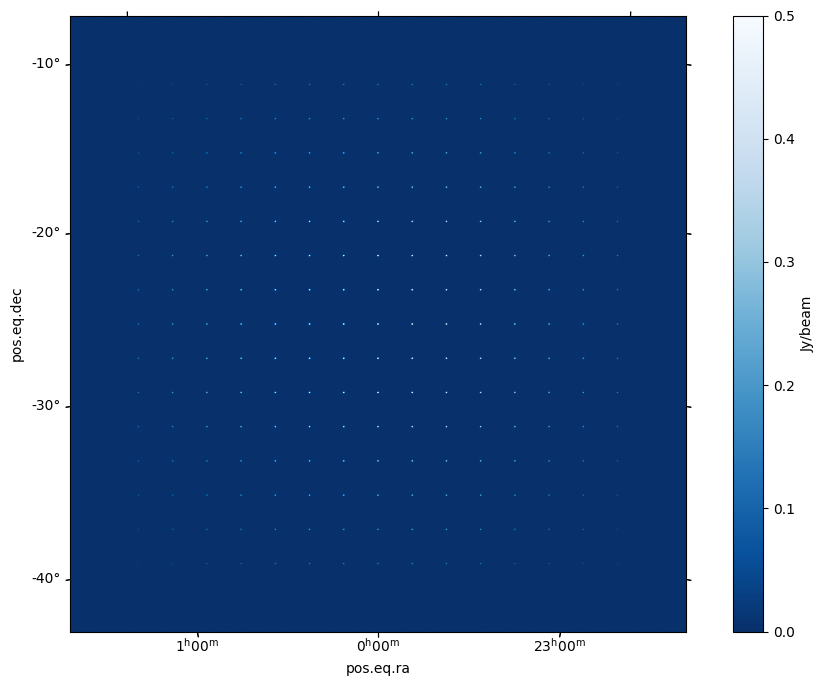
Looks like the point sources toward the edge are being tapered off ala a good old MWA primary beam lobe, so huzzah.
Interpolated beam
Can we use the interpolated Daniel Ung .h5 file for highband? Let’s try it.
from astropy.table import Column, Table
import numpy as np
import os

sing_ra = 15.0
sing_dec = -40.0

ras = [sing_ra]
decs = [sing_dec]

num_comps = len(ras)

c_ids = Column(data=np.array(['source']*num_comps), name='UNQ_SOURCE_ID', dtype='|S20')
c_names = Column(data=np.array([f'source_C{i:04d}' for i in range(num_comps)]), name='NAME', dtype='|S20')

##Component position
c_ras = Column(data=ras, name='RA')
c_decs = Column(data=decs, name='DEC')

##This says we have a point source
c_comp_types = Column(data=np.array(['P']*num_comps, dtype='|S1'), name="COMP_TYPE", dtype='|S1')
##This says we have a Stokes I power-law SED
c_mod_types = Column(data=np.array(['pl']*num_comps, dtype='|S3'), name="MOD_TYPE", dtype='|S3')

##Set everything as a flat spectrum 1 Jy stokes I source. That way we can image it and see the beam pattern
c_stokes_I_ref = Column(data=np.ones(num_comps), name='NORM_COMP_PL')
c_stokes_I_SI = Column(data=np.zeros(num_comps), name='ALPHA_PL')


cols = [c_ids, c_names, c_ras, c_decs, c_comp_types, c_mod_types, c_stokes_I_ref, c_stokes_I_SI]

main_table = Table(cols)

single_cat = 'single_point.fits'

main_table.write(single_cat, format='fits', overwrite=True)


ra0=0.0
dec0=-26.7
date="2024-07-21T20:13:00"
primary_beam="everybeam_MWA"
num_times=1
num_freq_chans=390
low_freq=167e+6
ms_path="MWA-single-timeslot.ms"
uvfits_name="interp_run_woden"
freq_reso=80e+3

args = []

interp_h5 = os.environ['MWA_FEE_HDF5_INTERP']

args.append(f'--ra0={sing_ra}')
args.append(f'--dec0={-sing_dec}')
args.append(f'--metafits_filename=1125949472_metafits.fits')
args.append(f'--output_uvfits_prepend={uvfits_name}')
args.append(f'--primary_beam={primary_beam}')
args.append(f'--beam_ms_path={ms_path}')
args.append(f'--freq_res={freq_reso}')
args.append(f'--band_nums=1')
args.append(f'--num_time_steps={num_times}')
args.append(f'--IAU_order')
args.append(f'--station_id=0')
args.append(f'--cat_filename={single_cat}')
args.append(f'--lowest_channel_freq={low_freq}')
args.append(f'--num_freq_channels={num_freq_chans}')
args.append(f'--time_res=2')
args.append(f'--num_threads=1')
args.append(f'--hdf5_beam_path={interp_h5}')

run_woden(args)
Successful readonly open of default-locked table MWA-single-timeslot.ms/ANTENNA: 8 columns, 128 rows
You are using WODEN commit: No git describe nor __version__ avaible
LOADING IN /home/jline/software/WODEN_dev/wodenpy/libwoden_double.so
Setting phase centre RA,DEC 15.00000deg 40.00000deg
Obs epoch initial LST was 42.2620215148 deg
Setting initial J2000 LST to 42.0911874758 deg
Setting initial mjd to 57275.8224074073
After precession initial latitude of the array is -26.7665041369 deg
We are precessing the array
Doing the initial reading/mapping of sky model into chunks
INFO: couldn't find second table containing shapelet information, so not attempting to load any shapelets.
Mapping took 0.0 mins
Have read in 1 components
After cropping there are 1 components
From Set 0 thread num 0 reading 1 points, 0 gauss, 0 shape, 0 shape coeffs using thread id 0
Finshed thread 0 in 377.9 seconds
Sending set 0 to GPU
Set 0 has returned from the GPU after 1.3 seconds
coarse_h5 = os.environ['MWA_FEE_HDF5']

uvfits_name = 'coarse_run_woden'

args.append(f'--ra0={sing_ra}')
args.append(f'--dec0={-sing_dec}')
args.append(f'--metafits_filename=1125949472_metafits.fits')
args.append(f'--output_uvfits_prepend={uvfits_name}')
args.append(f'--primary_beam={primary_beam}')
args.append(f'--beam_ms_path={ms_path}')
args.append(f'--freq_res={freq_reso}')
args.append(f'--band_nums=1')
args.append(f'--num_time_steps={num_times}')
args.append(f'--IAU_order')
args.append(f'--station_id=0')
args.append(f'--cat_filename={single_cat}')
args.append(f'--lowest_channel_freq={low_freq}')
args.append(f'--num_freq_channels={num_freq_chans}')
args.append(f'--time_res=2')
args.append(f'--num_threads=1')
args.append(f'--hdf5_beam_path={coarse_h5}')

run_woden(args)
Successful readonly open of default-locked table MWA-single-timeslot.ms/ANTENNA: 8 columns, 128 rows
You are using WODEN commit: No git describe nor __version__ avaible
LOADING IN /home/jline/software/WODEN_dev/wodenpy/libwoden_double.so
Setting phase centre RA,DEC 15.00000deg 40.00000deg
Obs epoch initial LST was 42.2620215148 deg
Setting initial J2000 LST to 42.0911874758 deg
Setting initial mjd to 57275.8224074073
After precession initial latitude of the array is -26.7665041369 deg
We are precessing the array
Doing the initial reading/mapping of sky model into chunks
INFO: couldn't find second table containing shapelet information, so not attempting to load any shapelets.
Mapping took 0.0 mins
Have read in 1 components
After cropping there are 1 components
From Set 0 thread num 0 reading 1 points, 0 gauss, 0 shape, 0 shape coeffs using thread id 0
Finshed thread 0 in 32.6 seconds
Sending set 0 to GPU
Set 0 has returned from the GPU after 0.8 seconds
xx_interp, xy_interp, yx_interp, yy_interp = read_uvfits('interp_run_woden_band01.uvfits')
xx_coarse, xy_coarse, yx_coarse, yy_coarse = read_uvfits('coarse_run_woden_band01.uvfits')

freqs = np.arange(low_freq, low_freq + num_freq_chans*freq_reso, freq_reso)

xx_abs = np.abs(xx_coarse[0])
plt.plot(freqs/1e+6, xx_abs, label='Coarse h5 file')

xx_abs = np.abs(xx_interp[0])
plt.plot(freqs/1e+6, xx_abs, label='Interpolated h5 file')
plt.xlabel('Frequency (MHz)')
plt.ylabel('XX Amplitude')
plt.legend()
plt.show()
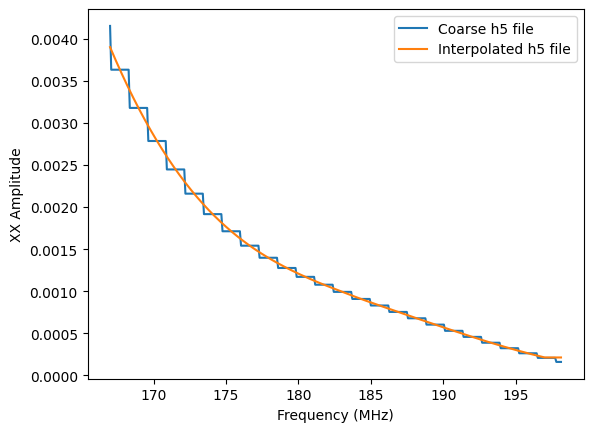
Yup, seems like we can indeed. It is over 10x slower however. I’m calling EveryBeam the exact same number of times, as I already call it for every frequency. Maybe EveryBeam is smart enough to cache frequency outputs?