EveryBeam LOFAR HBA integration tests
These tests are all setup and explained in test_OSKAR-MWA.ipynb, so check that out first if you haven’t already.
Goes without saying, but these tests rely on everybeam being installed.
import sys
##This line is to make EveryBeam work on my machine; adjust as necessary for yours
sys.path.append('/home/jline/software/installed/lib/python3.12/site-packages')
sys.path.append('../../scripts')

from run_woden import main as run_woden

from subprocess import call
from astropy.io import fits
import numpy as np
from astropy.table import Column, Table
from astropy.time import Time
from astropy.coordinates import SkyCoord
from astropy.coordinates import EarthLocation
from astropy import units as u
import matplotlib.pyplot as plt
import numpy.testing as npt
from astropy.constants import c
from astropy.wcs import WCS
import everybeam as eb
import erfa

##A bunch of test and plotting code lives here so we can use it in multile notebooks
from wodenpy.primary_beam.use_everybeam import load_MWA_telescope, load_OSKAR_telescope, load_LOFAR_telescope, run_everybeam, radec_to_xyz, run_everybeam_over_threads
##A bunch of test and plotting code lives here so we can use it in multile notebooks
from eb_testing_code import create_WCS, plot_jones_on_sky, plot_everybeam_on_sky, make_sky_models, read_uvfits, convert_inst_to_stokes, test_stokes_recovery, getFDF, findpeaks, test_RM_recovery, make_RM_skymodel

from wodenpy.array_layout.precession import RTS_Precess_LST_Lat_to_J2000

C = c.to('m/s').value

ra0 = 0
dec0 = 53

lofar_lat = 52.905329712
lofar_long = 6.867996528

##pick a time/date that sticks our phase centre overhead
date = "2024-07-21T03:35:00"
##Assume that the OSKAR telescope is near the MWA??
lofar_location = EarthLocation(lat=lofar_lat*u.deg,
                               lon=lofar_long*u.deg)

observing_time = Time(date, scale='utc', location=lofar_location)

##Grab the LST
LST = observing_time.sidereal_time('mean')
LST_deg = LST.value*15
print(f"LST: {LST_deg} deg, RA: {ra0}")
LST: 0.01862197128531748 deg, RA: 0
Image the beam on the sky
First up, let’s see if we can just plot a LOFAR station beam to check it looks sensible.
##setup coords
nside = 100
radec_reso = 60 / nside
header, wcs = create_WCS(ra0, dec0, nside, radec_reso)
x_mesh, y_mesh = np.meshgrid(np.arange(nside), np.arange(nside))
ras, decs = wcs.all_pix2world(x_mesh, y_mesh, 0)
ras = np.radians(ras.flatten())
decs = np.radians(decs.flatten())

##Path to example MS
ms_path="LOFAR_HBA_MOCK.ms"

freq = 150e+6
station_id = 0

##Technically we don't need to do this here, but in WODEN proper, we
##precess the array back to J2000 rather than precessing the sky forward
##So doing it here to show you what is happening under the hood
mjd_current = observing_time.mjd
lst_J2000, latitude_J2000 = RTS_Precess_LST_Lat_to_J2000(np.radians(LST_deg),
                                                         np.radians(lofar_lat),
                                                         mjd_current)

##Stick all our variables in lists as `run_everybeam` is designed to be
## run over multiple times/frequencies
j2000_latitudes = [latitude_J2000]
j2000_lsts = [lst_J2000]
times = [observing_time]
freqs = [freq]
station_ids = [0]
##Everybeam doesn't need a coeff path for this beam
coeff_path=""

##We'll run EveryBeam in parallel to speed things up
num_threads=8

all_jones = run_everybeam_over_threads(num_threads, ms_path,
                            coeff_path,
                            ras, decs,
                            np.radians(ra0), np.radians(dec0),
                            j2000_latitudes, j2000_lsts,
                            np.radians(lofar_lat), np.radians(lofar_long),
                            times, freqs, station_ids,
                            use_differential_beam=False,
                            apply_beam_norms=True,
                            reorder_jones=False,
                            parallactic_rotate=False,
                            eb_rotate=True)

beam_ind, time_ind, freq_ind = 0, 0, 0

all_gx = all_jones[beam_ind, time_ind, freq_ind, :, 0, 0]
all_Dx = all_jones[beam_ind, time_ind, freq_ind, :, 0, 1]
all_Dy = all_jones[beam_ind, time_ind, freq_ind, :, 1, 0]
all_gy = all_jones[beam_ind, time_ind, freq_ind, :, 1, 1]

all_gx.shape = (nside, nside)
all_Dx.shape = (nside, nside)
all_Dy.shape = (nside, nside)
all_gy.shape = (nside, nside)

plot_jones_on_sky(all_gx, all_Dx, all_Dy, all_gy, wcs)
Thread 6 processing coords 7500 to 8750Thread 7 processing coords 8750 to 10000
Thread 1 processing coords 1250 to 2500
Thread 2 processing coords 2500 to 3750
Thread 3 processing coords 3750 to 5000Thread 0 processing coords 0 to 1250
Thread 4 processing coords 5000 to 6250
Thread 5 processing coords 6250 to 7500


Thread 1 finishedThread 7 finished
Thread 2 finished
Thread 0 finished
Thread 4 finishedThread 3 finished
Thread 6 finished
Thread 5 finished
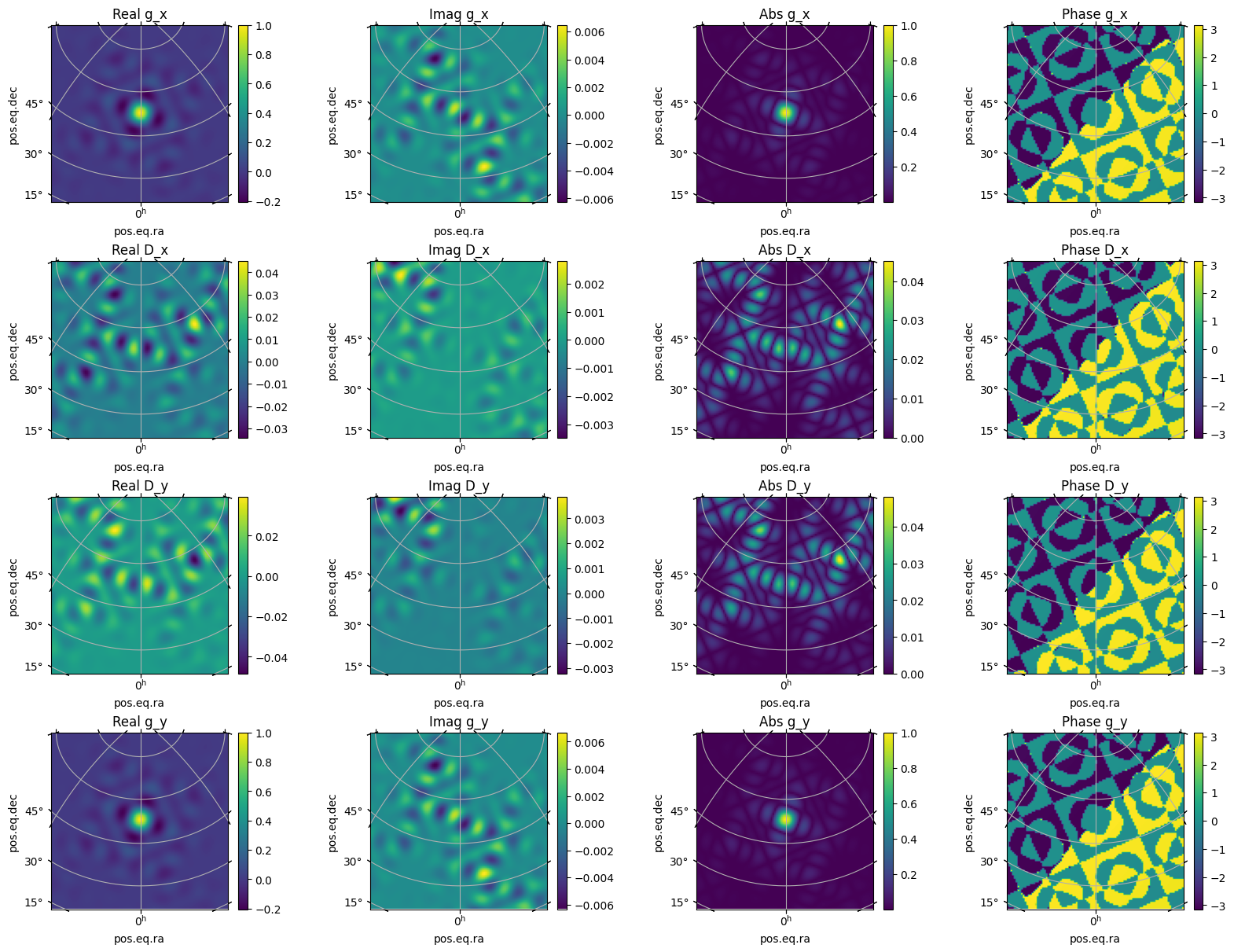
This looks decent, gains look way stronger than the leakages because I’ve set up the run_everybeam function to do a normalistion towards the beam phase centre. Same as LOFAR HBA, these dipoles are not aligned with the cardinal directions. The maths of all this is detailed in test_installation/everybeam/test_LOFAR_LBA.ipynb. We’ll do the same testing here as in that notebook.
Stokes recovery with off cardinal dipoles
Let’s try to recover single point source of either Stokes I, Q, U or V.
make_sky_models(ra0, dec0)

freq_reso=1e+6
low_freq=100e+6
high_freq = 150e+6
num_freq_chans = int((high_freq - low_freq) / freq_reso)
primary_beam = "everybeam_LOFAR"

for pol in ['I', 'Q', 'U', 'V']:
# for pol in ['I']:

    uvfits_name = f"stokes{pol}_{primary_beam}"
    cat_name = f'{pol}_source.fits'

    args = []

    ##The command to run WODEN
    args.append(f'--ra0={ra0}')
    args.append(f'--dec0={dec0}')
    args.append(f'--latitude={lofar_lat}')
    args.append(f'--longitude={lofar_long}')
    args.append(f'--date={date}')
    args.append(f'--output_uvfits_prepend={uvfits_name}')
    args.append(f'--cat_filename={cat_name}')
    args.append(f'--primary_beam={primary_beam}')
    args.append(f'--lowest_channel_freq={low_freq}')
    args.append(f'--freq_res={freq_reso}')
    args.append(f'--num_freq_channels={num_freq_chans}')
    args.append(f'--band_nums=1')
    args.append(f'--time_res=2')
    args.append(f'--num_time_steps=1')
    args.append(f'--IAU_order')
    args.append('--num_threads=1')
    args.append(f'--station_id=0')
    args.append(f'--beam_ms_path=LOFAR_HBA_MOCK.ms')

    run_woden(args)
Successful readonly open of default-locked table LOFAR_HBA_MOCK.ms/ANTENNA: 10 columns, 70 rows
You are using WODEN commit: No git describe nor __version__ avaible
LOADING IN /home/jline/software/WODEN_dev/wodenpy/libwoden_double.so
Setting phase centre RA,DEC 0.00000deg 53.00000deg
Obs epoch initial LST was 0.0228000546 deg
Setting initial J2000 LST to 359.7122369008 deg
Setting initial mjd to 60512.1493171296
After precession initial latitude of the array is 52.7688502802 deg
We are precessing the array
Doing the initial reading/mapping of sky model into chunks
INFO: couldn't find second table containing shapelet information, so not attempting to load any shapelets.
Mapping took 0.0 mins
Have read in 1 components
After cropping there are 1 components
From Set 0 thread num 0 reading 1 points, 0 gauss, 0 shape, 0 shape coeffs using thread id 0
Finshed thread 0 in 0.4 seconds
Sending set 0 to GPU
Set 0 has returned from the GPU after 0.8 seconds
Successful readonly open of default-locked table LOFAR_HBA_MOCK.ms/ANTENNA: 10 columns, 70 rows
You are using WODEN commit: No git describe nor __version__ avaible
LOADING IN /home/jline/software/WODEN_dev/wodenpy/libwoden_double.so
Setting phase centre RA,DEC 0.00000deg 53.00000deg
Obs epoch initial LST was 0.0228000546 deg
Setting initial J2000 LST to 359.7122369008 deg
Setting initial mjd to 60512.1493171296
After precession initial latitude of the array is 52.7688502802 deg
We are precessing the array
Doing the initial reading/mapping of sky model into chunks
Mapping took 0.0 mins
Have read in 1 components
After cropping there are 1 components
From Set 0 thread num 0 reading 1 points, 0 gauss, 0 shape, 0 shape coeffs using thread id 0
Finshed thread 0 in 0.3 seconds
Sending set 0 to GPU
Set 0 has returned from the GPU after 0.1 seconds
Successful readonly open of default-locked table LOFAR_HBA_MOCK.ms/ANTENNA: 10 columns, 70 rows
You are using WODEN commit: No git describe nor __version__ avaible
LOADING IN /home/jline/software/WODEN_dev/wodenpy/libwoden_double.so
Setting phase centre RA,DEC 0.00000deg 53.00000deg
Obs epoch initial LST was 0.0228000546 deg
Setting initial J2000 LST to 359.7122369008 deg
Setting initial mjd to 60512.1493171296
After precession initial latitude of the array is 52.7688502802 deg
We are precessing the array
Doing the initial reading/mapping of sky model into chunks
Mapping took 0.0 mins
Have read in 1 components
After cropping there are 1 components
From Set 0 thread num 0 reading 1 points, 0 gauss, 0 shape, 0 shape coeffs using thread id 0
Finshed thread 0 in 0.2 seconds
Sending set 0 to GPU
Set 0 has returned from the GPU after 0.1 seconds
Successful readonly open of default-locked table LOFAR_HBA_MOCK.ms/ANTENNA: 10 columns, 70 rows
You are using WODEN commit: No git describe nor __version__ avaible
LOADING IN /home/jline/software/WODEN_dev/wodenpy/libwoden_double.so
Setting phase centre RA,DEC 0.00000deg 53.00000deg
Obs epoch initial LST was 0.0228000546 deg
Setting initial J2000 LST to 359.7122369008 deg
Setting initial mjd to 60512.1493171296
After precession initial latitude of the array is 52.7688502802 deg
We are precessing the array
Doing the initial reading/mapping of sky model into chunks
INFO: couldn't find second table containing shapelet information, so not attempting to load any shapelets.
Mapping took 0.0 mins
Have read in 1 components
After cropping there are 1 components
From Set 0 thread num 0 reading 1 points, 0 gauss, 0 shape, 0 shape coeffs using thread id 0
Finshed thread 0 in 0.2 seconds
Sending set 0 to GPU
Set 0 has returned from the GPU after 0.1 seconds
for pol in ['I', 'Q', 'U', 'V']:
    uvfits_name = f"stokes{pol}_everybeam_LOFAR"
    XX, XY, YX, YY = read_uvfits(f'{uvfits_name}_band01.uvfits')

    test_stokes_recovery(pol, 'none', atol=5e-2, on_cardinal=False)

    # ##uncomment to print responses
    # ##pick a random baseline to plot, they should all be the sam
    # baseline = 0
    # ##Supplu on_cardinal=False to use the right maths
    # recover_I, recover_Q, recover_U, recover_V = convert_inst_to_stokes(XX[baseline], XY[baseline], YX[baseline], YY[baseline],
    #                                             on_cardinal=False)
    # print(f"Input {pol}, Recover I {recover_I[0].real:.2f}, Q {recover_Q[0].real:.2f}, U {recover_U[0].real:.2f}, V {recover_V[0].real:.2f}")
Testing Stokes I
Stokes I passed
Testing Stokes Q
Stokes Q passed
Testing Stokes U
Stokes U passed
Testing Stokes V
Stokes V passed
Booya, works perfectly. Now to test the RM recovery.
RM recovery
phi_RM, pol_frac = make_RM_skymodel(ra0, dec0)

freq_reso = 0.1e+6
low_freq = 100e+6
high_freq = 130e+6
num_freq_chans = int((high_freq - low_freq) / freq_reso)


primary_beam = "everybeam_LOFAR"

uvfits_name = f"rm_source_{primary_beam}"
cat_name = 'RM_source.fits'

##The command to run WODEN
command = f'run_woden.py --ra0={ra0} --dec0={dec0} '
command += f'--date={date} --output_uvfits_prepend={uvfits_name} '
command += f'--latitude={lofar_lat} --longitude={lofar_long} '
command += f'--cat_filename={cat_name} --primary_beam={primary_beam} '
command += f'--lowest_channel_freq={low_freq} --freq_res={freq_reso} '
command += f'--num_freq_channels={num_freq_chans} --band_nums=1 '
command += f'--time_res=2 --num_time_steps=1 --IAU_order --num_threads=1 '
command += f' --station_id=0 '
command += f'--beam_ms_path=LOFAR_HBA_MOCK.ms'

call(command, shell=True)
/home/jline/software/anaconda3/envs/woden_dev/bin/run_woden.py:4: DeprecationWarning: pkg_resources is deprecated as an API. See https://setuptools.pypa.io/en/latest/pkg_resources.html
  __import__('pkg_resources').require('wodenpy==2.3.0')
Successful readonly open of default-locked table LOFAR_HBA_MOCK.ms/ANTENNA: 10 columns, 70 rows
You are using WODEN commit: No git describe nor __version__ avaible
LOADING IN /home/jline/software/WODEN_dev/wodenpy/libwoden_double.so
Setting phase centre RA,DEC 0.00000deg 53.00000deg
Obs epoch initial LST was 0.0228000546 deg
Setting initial J2000 LST to 359.7122369008 deg
Setting initial mjd to 60512.1493171296
After precession initial latitude of the array is 52.7688502802 deg
We are precessing the array
Doing the initial reading/mapping of sky model into chunks
INFO: couldn't find second table containing shapelet information, so not attempting to load any shapelets.
Mapping took 0.0 mins
Have read in 1 components
After cropping there are 1 components
From Set 0 thread num 0 reading 1 points, 0 gauss, 0 shape, 0 shape coeffs using thread id 0
Finshed thread 0 in 0.2 seconds
Sending set 0 to GPU
Set 0 has returned from the GPU after 0.5 seconds
0
XX, XY, YX, YY = read_uvfits('rm_source_everybeam_LOFAR_band01.uvfits')
baseline = 0
recover_I, recover_Q, recover_U, recover_V = convert_inst_to_stokes(XX[baseline], XY[baseline], YX[baseline], YY[baseline],
                                                                    on_cardinal=False)


freqs = np.arange(low_freq, high_freq, freq_reso)

fig, axs = plt.subplots(1, 1, figsize=(8, 6))

axs.plot(freqs / 1e+6, recover_I.real, 'k-', label='Recovered I')
axs.plot(freqs / 1e+6, recover_Q.real, 'r', label='Recovered Q')
axs.plot(freqs / 1e+6, recover_U.real, 'b', label='Recovered U')
axs.plot(freqs / 1e+6, recover_V.real, 'g', label='Recovered V')

axs.legend()

axs.set_xlabel('Frequency (MHz)')
axs.set_ylabel('Flux (Jy)')

plt.show()
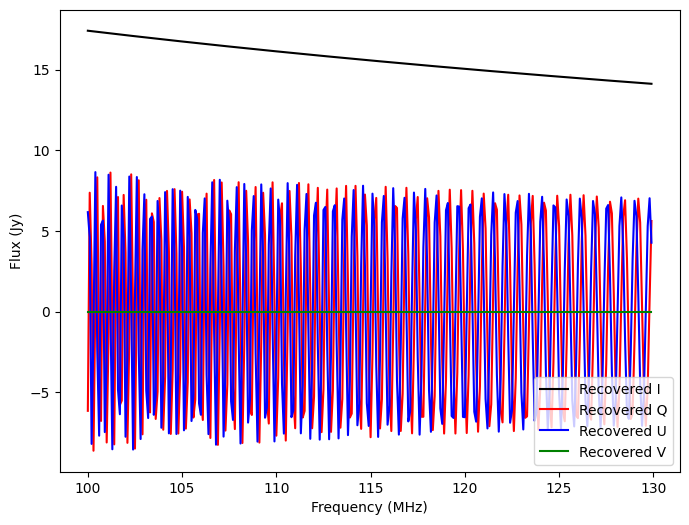
test_RM_recovery(uvfits_name, phi_RM, pol_frac, freqs, atol=0.02)
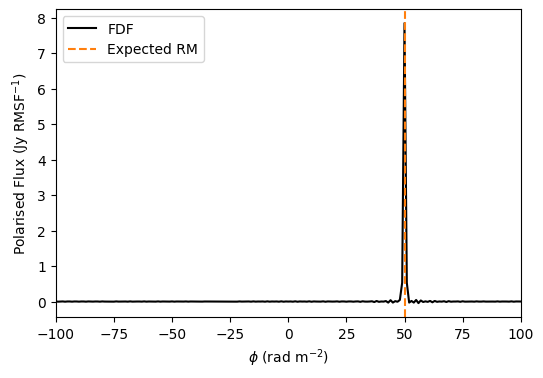
Recovered RM: 50.0 Expected RM: 50
Recovered Pol. Fraction: 0.5 Expected Pol Fraction 0.5
Looks good.
Test unique primary beam per station
run_everybeam (which is called by run_everybeam_over_threads) has been setup to run any given number of stations, times, frequencies and directions. Here we’ll test things are returned in the expecting order by running two times and two frequencies. As waiting around is boring, we’ll also run things across multiple threads; this is a mircocosm of what happens in run_woden.py, as we split the sky model reading and beam calculations across threads.
from astropy.time import TimeDelta

ms_path="LOFAR_HBA_MOCK.ms"

telescope = load_LOFAR_telescope(ms_path)

##Setup a grid of RA/Dec on the sky
nside=128
radec_reso = 100/nside

##lock frame to first LST, so we can see if beam is locked to RA/Dec
header, wcs = create_WCS(ra0, dec0, nside, radec_reso)
x_mesh, y_mesh = np.meshgrid(np.arange(nside), np.arange(nside))
ras, decs = wcs.all_pix2world(x_mesh, y_mesh, 0)

ras = np.radians(ras.flatten())
decs = np.radians(decs.flatten())

num_comps = len(ras)
num_beams = telescope.nr_stations

##Do a couple of frequencies to check mapping is working
all_freqs = np.array([100e+6, 150e+6])

##Do two times, 4 hours apart to check things move on the sky
##Our obs frame is locked to beam phase, so should still be centred, but it'll
##be elongated due to projection effects/pointing
all_times = np.array([observing_time, observing_time + TimeDelta(4*3600, format='sec')])

station_ids = np.arange(num_beams)

num_threads=8

j2000_latitudes = []
j2000_lsts = []

for time in all_times:
    LST_deg = time.sidereal_time('mean').value*15

    mjd_current = time.mjd
    lst_J2000, latitude_J2000 = RTS_Precess_LST_Lat_to_J2000(np.radians(LST_deg),
                                                         np.radians(lofar_lat),
                                                         mjd_current)
    j2000_latitudes.append(latitude_J2000)
    j2000_lsts.append(lst_J2000)

##Everybeam doesn't need a coeff path for this beam
coeff_path=""

##We'll run EveryBeam in parallel to speed things up
num_threads=8

all_jones = run_everybeam_over_threads(num_threads, ms_path,
                            coeff_path,
                            ras, decs,
                            np.radians(ra0), np.radians(dec0),
                            j2000_latitudes, j2000_lsts,
                            np.radians(lofar_lat), np.radians(lofar_long),
                            all_times, all_freqs, station_ids,
                            use_differential_beam=False,
                            apply_beam_norms=True,
                            reorder_jones=False,
                            parallactic_rotate=False,
                            eb_rotate=True)
Thread 0 processing coords 0 to 2048
Thread 2 processing coords 4096 to 6144
Thread 1 processing coords 2048 to 4096Thread 3 processing coords 6144 to 8192
Thread 5 processing coords 10240 to 12288

Thread 6 processing coords 12288 to 14336Thread 4 processing coords 8192 to 10240

Thread 7 processing coords 14336 to 16384
/home/jline/software/anaconda3/envs/woden_dev/lib/python3.12/site-packages/erfa/core.py:4642: RuntimeWarning: invalid value encountered in ld
  p1 = ufunc.ld(bm, p, q, e, em, dlim)
/home/jline/software/anaconda3/envs/woden_dev/lib/python3.12/site-packages/erfa/core.py:19026: RuntimeWarning: invalid value encountered in anp
  c_retval = ufunc.anp(a)
/home/jline/software/anaconda3/envs/woden_dev/lib/python3.12/site-packages/erfa/core.py:4642: RuntimeWarning: invalid value encountered in ld
  p1 = ufunc.ld(bm, p, q, e, em, dlim)
/home/jline/software/anaconda3/envs/woden_dev/lib/python3.12/site-packages/erfa/core.py:19026: RuntimeWarning: invalid value encountered in anp
  c_retval = ufunc.anp(a)
/home/jline/software/anaconda3/envs/woden_dev/lib/python3.12/site-packages/erfa/core.py:4642: RuntimeWarning: invalid value encountered in ld
  p1 = ufunc.ld(bm, p, q, e, em, dlim)
/home/jline/software/anaconda3/envs/woden_dev/lib/python3.12/site-packages/erfa/core.py:19026: RuntimeWarning: invalid value encountered in anp
  c_retval = ufunc.anp(a)
/home/jline/software/anaconda3/envs/woden_dev/lib/python3.12/site-packages/erfa/core.py:4642: RuntimeWarning: invalid value encountered in ld
  p1 = ufunc.ld(bm, p, q, e, em, dlim)
/home/jline/software/anaconda3/envs/woden_dev/lib/python3.12/site-packages/erfa/core.py:19026: RuntimeWarning: invalid value encountered in anp
  c_retval = ufunc.anp(a)
Thread 2 finished
Thread 5 finished
Thread 3 finished
Thread 4 finished
Thread 1 finished
Thread 0 finished
Thread 7 finished
Thread 6 finished
OK, now setup code to plot the the absolute values of the first polarisation for the first 36 stations, per time, per freq, to check our outputs.
def plot_beam_selection(all_jones, time_ind, freq_ind, nside, wcs):
    fig, axs = plt.subplots(6, 6, figsize=(12, 12), layout='constrained',
                            subplot_kw={'projection': wcs})

    for col in range(6):
        for row in range(6):
            beam_ind = col*6 + row

            gx = all_jones[beam_ind, time_ind, freq_ind, :, 0,0]
            gx.shape = (nside, nside)

            im = axs[row, col].imshow(np.abs(gx), origin='lower', vmax=1, vmin=0)

            axs[row, col].grid(alpha=0.5)

            lon = axs[row, col].coords[0]
            lat = axs[row, col].coords[1]

            lon.set_ticks_visible(False)
            lat.set_ticks_visible(False)
            lon.set_axislabel(' ')
            lat.set_axislabel(' ')


            if col > 0:
                lat.set_ticklabel_visible(False)
            if row < 5:
                lon.set_ticklabel_visible(False)

            if col == 5:
                plt.colorbar(im, ax=axs[row, col])


    fig.suptitle(f"Time: {all_times[time_ind].isot}, Freq: {all_freqs[freq_ind]/1e+6} MHz")

    plt.show()

time_ind = 0
freq_ind = 0
plot_beam_selection(all_jones, time_ind, freq_ind, nside, wcs)
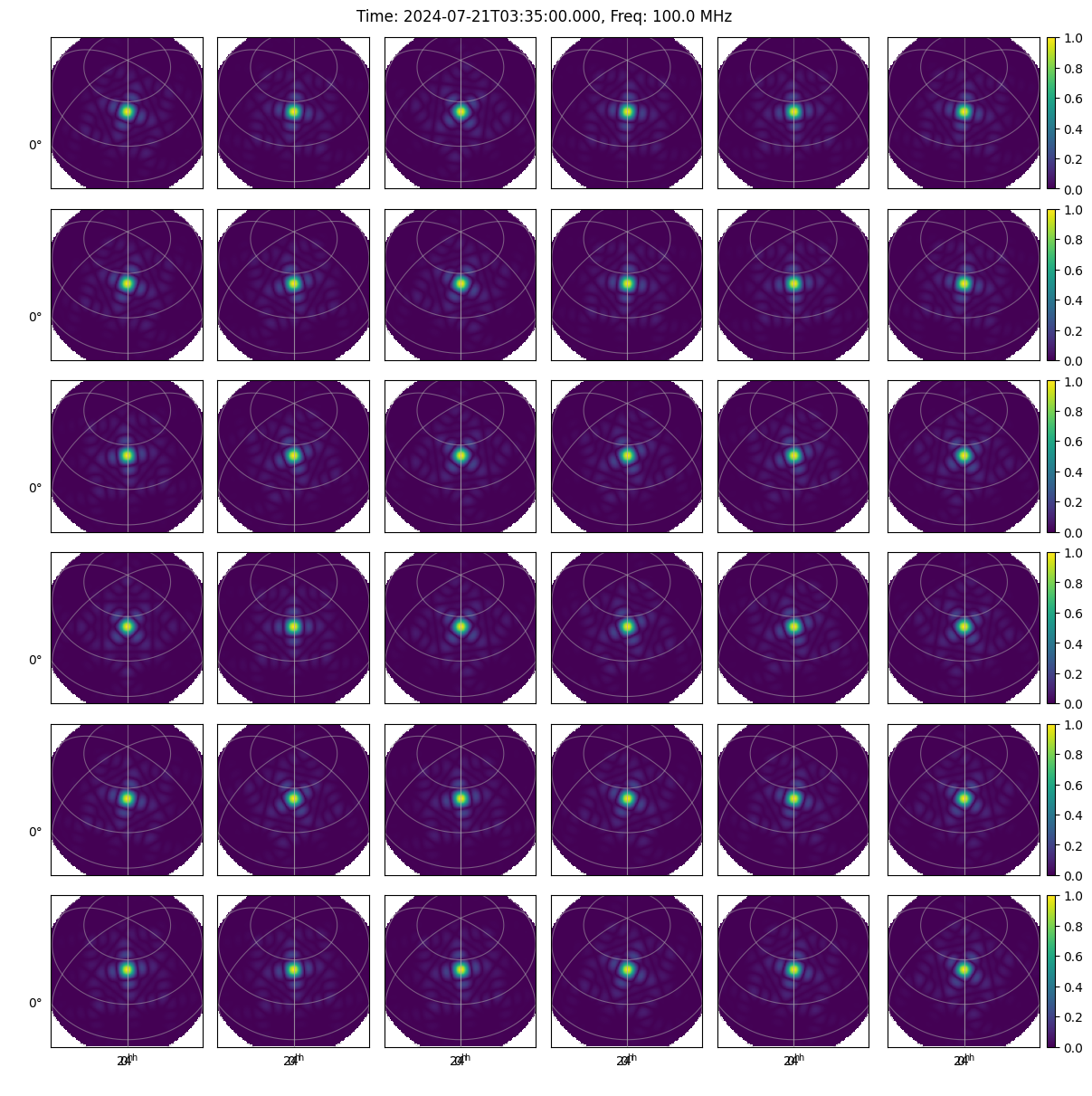
Cool, we get a different primary beam shape for each station, they’re all normalised to 1. So far so good.
time_ind = 0
freq_ind = 1
plot_beam_selection(all_jones, time_ind, freq_ind, nside, wcs)
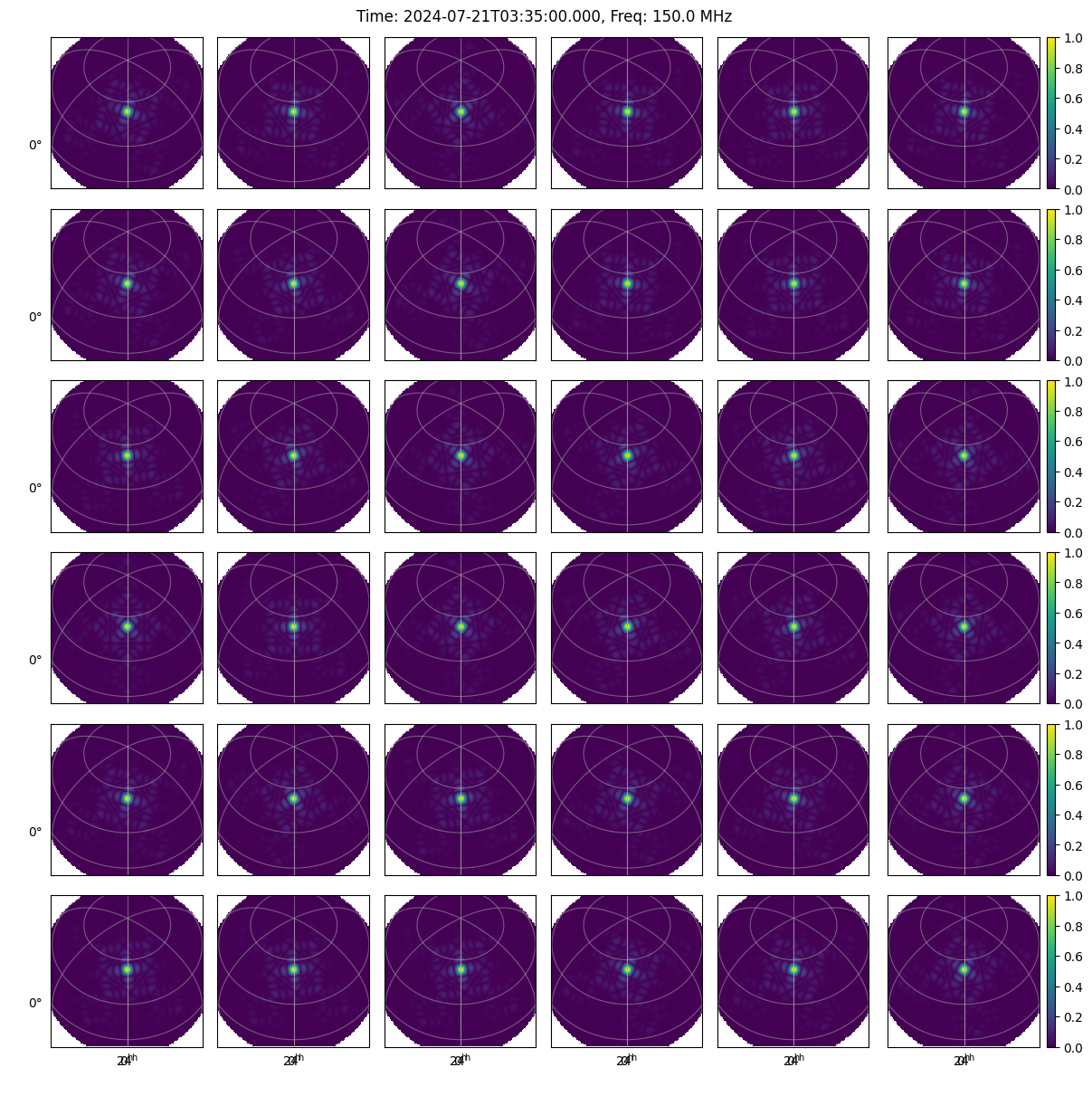
Yup, if we switch from 100 to 150MHz the beam gets smaller on the sky, happy days.
time_ind = 1
freq_ind = 0
plot_beam_selection(all_jones, time_ind, freq_ind, nside, wcs)
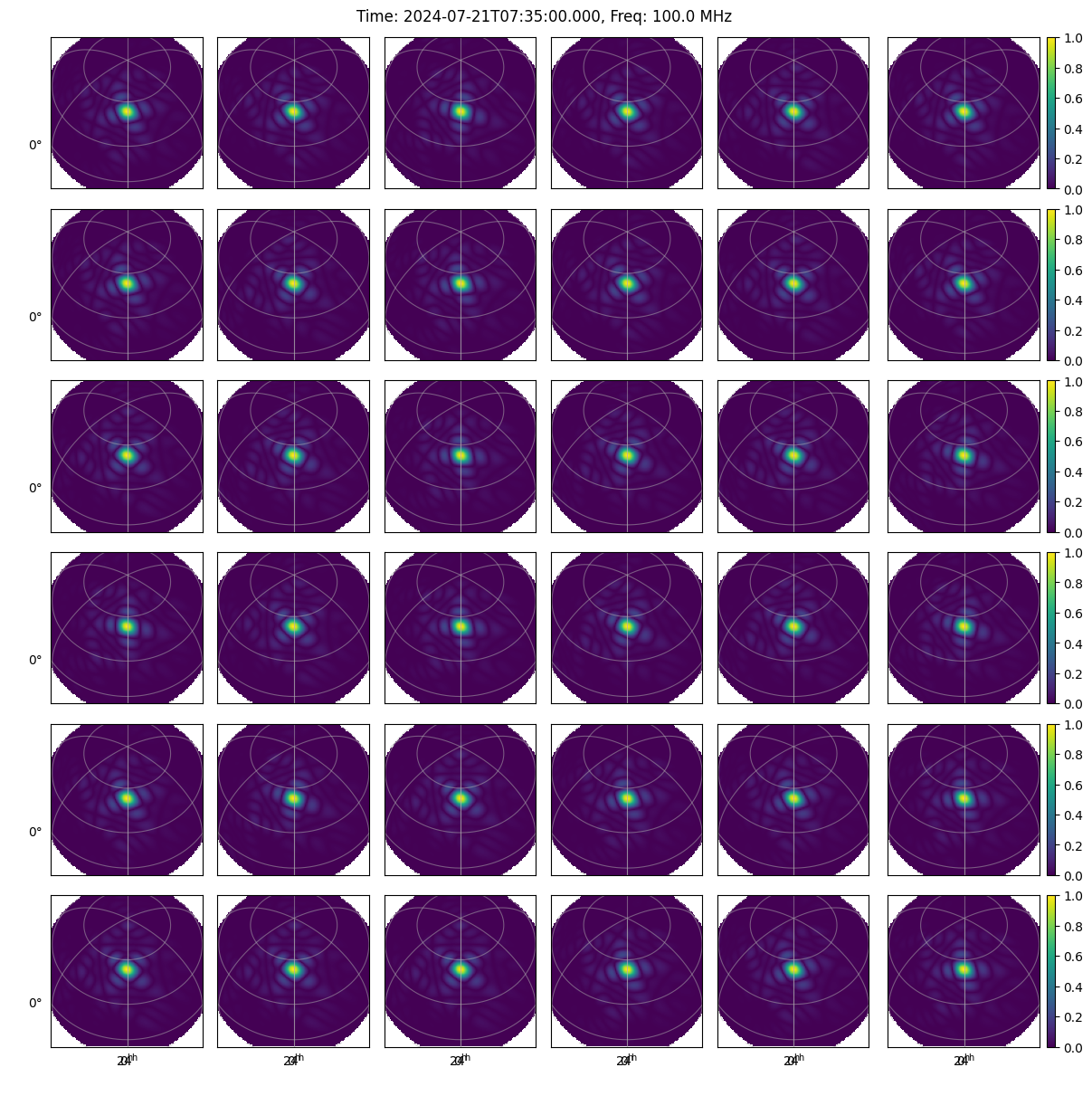
Now we’ve gone from beam at zenith to 4 hours off zenith. We’re still plotting with RA/Dec centred on beam, but we can see projection effects so we are defo off zenith.
time_ind = 1
freq_ind = 1
plot_beam_selection(all_jones, time_ind, freq_ind, nside, wcs)
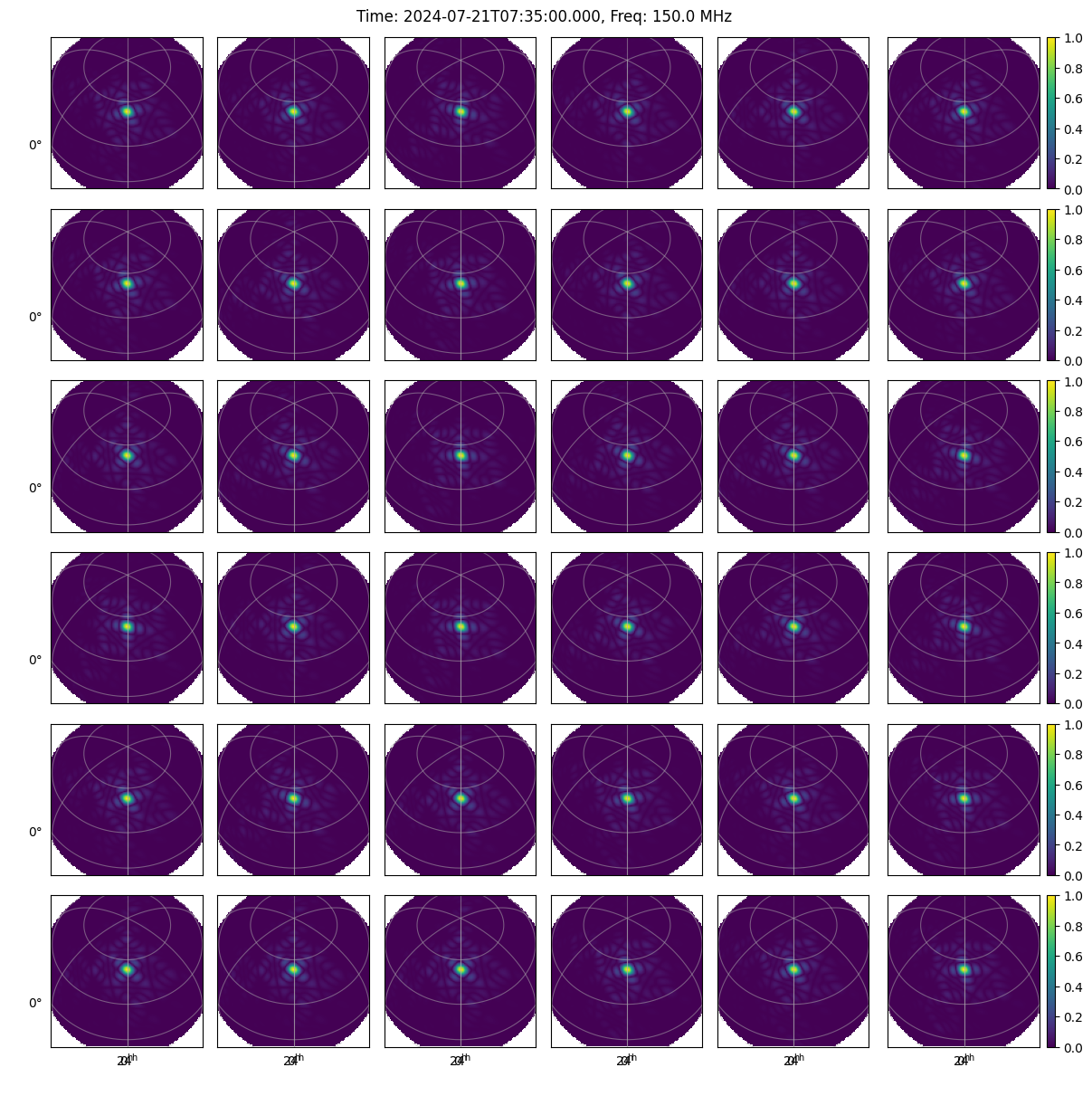
And again changing freq changes size. Things are looking good.
Averaging over stations
As I’m an MWA person, I’m interested to see what happens to the sidelobes when we average over stations. Here we’ll average over all the stations and plot a single station vs the average.
freq_ind, time_ind = 0, 0

all_gx = all_jones[:, time_ind, freq_ind, :, 0, 0]
all_gx.shape = (num_beams, nside, nside)

avg_beams = np.mean(all_gx, axis=0)

fig, axs = plt.subplots(1, 2, figsize=(12, 4), subplot_kw={'projection': wcs})


im = axs[0].imshow(np.log10(np.abs(all_gx[0])), origin='lower', vmin=-6, vmax=0)
plt.colorbar(im, ax=axs[0], label='log absolute gain')
axs[0].set_title('Station 0 beam')

im = axs[1].imshow(np.log10(np.abs(avg_beams)), origin='lower', vmin=-6, vmax=0)
plt.colorbar(im, ax=axs[1], label='log absolute gain')
axs[1].set_title('Average beam')

plt.show()
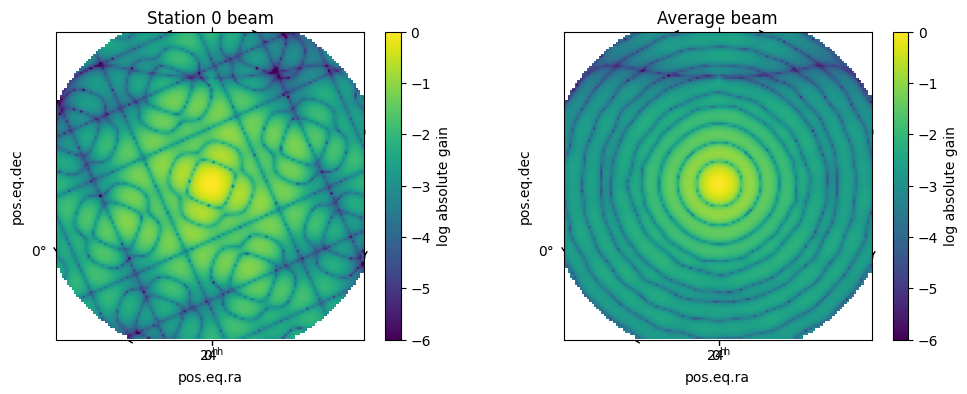
Huh cool, essentially turns into an airy disk.
Check positions of components via image
Let’s bung a grid of RA/Dec through the whole simulation code, so multiple frequencies and time steps. This should check we’re calling the above beam code correctly and integrating things into the code proper.
from astropy.table import Column, Table

nside=11
half_width = 2

ras = np.linspace(ra0 - half_width, ra0 + half_width, nside)
decs = np.linspace(dec0 - half_width, dec0 + half_width, nside)

ras, decs = np.meshgrid(ras, decs)

ras = ras.flatten()
decs = decs.flatten()

num_comps = len(ras)

c_ids = Column(data=np.array(['source']*num_comps), name='UNQ_SOURCE_ID', dtype='|S20')
c_names = Column(data=np.array([f'source_C{i:04d}' for i in range(num_comps)]), name='NAME', dtype='|S20')

##Component position
c_ras = Column(data=ras, name='RA')
c_decs = Column(data=decs, name='DEC')

##This says we have a point source
c_comp_types = Column(data=np.array(['P']*num_comps, dtype='|S1'), name="COMP_TYPE", dtype='|S1')
##This says we have a Stokes I power-law SED
c_mod_types = Column(data=np.array(['pl']*num_comps, dtype='|S3'), name="MOD_TYPE", dtype='|S3')

##Set everything as a flat spectrum 1 Jy stokes I source. That way we can image it and see the beam pattern
c_stokes_I_ref = Column(data=np.ones(num_comps), name='NORM_COMP_PL')
c_stokes_I_SI = Column(data=np.zeros(num_comps), name='ALPHA_PL')


cols = [c_ids, c_names, c_ras, c_decs, c_comp_types, c_mod_types, c_stokes_I_ref, c_stokes_I_SI]

main_table = Table(cols)

cat_name = 'check_positions.fits'

main_table.write(cat_name, format='fits', overwrite=True)
args = []

primary_beam="everybeam_LOFAR"
low_freq=130e+6
num_freq_chans=100
freq_reso=1e+4
uvfits_name=f"check_positions_{primary_beam}"

##The command to run WODEN
args.append(f'--ra0={ra0}')
args.append(f'--dec0={dec0}')
args.append(f'--latitude={lofar_lat}')
args.append(f'--longitude={lofar_long}')
args.append(f'--date={date}')
args.append(f'--output_uvfits_prepend={uvfits_name}')
args.append(f'--cat_filename=check_positions.fits')
args.append(f'--primary_beam={primary_beam}')
args.append(f'--lowest_channel_freq={low_freq}')
args.append(f'--freq_res={freq_reso}')
args.append(f'--num_freq_channels={num_freq_chans}')
args.append(f'--band_nums=1')
args.append(f'--time_res=10')
args.append(f'--num_time_steps=10')
args.append(f'--IAU_order')
args.append('--num_threads=8')
args.append(f'--station_id=0')
args.append(f'--beam_ms_path=LOFAR_HBA_MOCK.ms')

run_woden(args)
Successful readonly open of default-locked table LOFAR_HBA_MOCK.ms/ANTENNA: 10 columns, 70 rows
You are using WODEN commit: No git describe nor __version__ avaible
LOADING IN /home/jline/software/WODEN_dev/wodenpy/libwoden_double.so
Setting phase centre RA,DEC 0.00000deg 53.00000deg
Obs epoch initial LST was 0.0395123880 deg
Setting initial J2000 LST to 359.7288967971 deg
Setting initial mjd to 60512.1493634259
After precession initial latitude of the array is 52.7688494985 deg
We are precessing the array
Doing the initial reading/mapping of sky model into chunks
INFO: couldn't find second table containing shapelet information, so not attempting to load any shapelets.
Mapping took 0.0 mins
Have read in 121 components
After cropping there are 121 components
From Set 0 thread num 1 reading 16 points, 0 gauss, 0 shape, 0 shape coeffs using thread id 1From Set 0 thread num 3 reading 16 points, 0 gauss, 0 shape, 0 shape coeffs using thread id 3From Set 0 thread num 5 reading 16 points, 0 gauss, 0 shape, 0 shape coeffs using thread id 5From Set 0 thread num 4 reading 16 points, 0 gauss, 0 shape, 0 shape coeffs using thread id 4From Set 0 thread num 2 reading 16 points, 0 gauss, 0 shape, 0 shape coeffs using thread id 2From Set 0 thread num 0 reading 16 points, 0 gauss, 0 shape, 0 shape coeffs using thread id 0


From Set 0 thread num 7 reading 9 points, 0 gauss, 0 shape, 0 shape coeffs using thread id 7

From Set 0 thread num 6 reading 16 points, 0 gauss, 0 shape, 0 shape coeffs using thread id 6


Finshed thread 6 in 1.7 seconds
Finshed thread 7 in 1.7 seconds
Finshed thread 1 in 1.8 seconds
Finshed thread 4 in 1.8 seconds
Finshed thread 3 in 1.9 seconds
Finshed thread 5 in 2.0 seconds
Finshed thread 0 in 2.1 seconds
Finshed thread 2 in 2.1 seconds
Sending set 0 to GPU
Set 0 has returned from the GPU after 2.6 seconds
cmd = "woden_uv2ms.py "
cmd += "  --uvfits_prepend=check_positions_everybeam_LOFAR_band "
cmd += "  --band_nums=1  "

call(cmd, shell=True)

cmd = "wsclean -name check_positions_everybeam_LOFAR -size 2048 2048 -niter 2000 "
cmd += "  -auto-threshold 0.5 -auto-mask 3 "
cmd += "  -pol I -multiscale -weight briggs 0 -scale 0.002 -j 12 -mgain 0.85 "
cmd += "  -no-update-model-required "
cmd += "  check_positions_everybeam_LOFAR_band*.ms "

##My local WSClean installation is borked, so I have to print the command and run it manually
print(cmd)
# call(cmd, shell=True)
/home/jline/software/anaconda3/envs/woden_dev/bin/woden_uv2ms.py:4: DeprecationWarning: pkg_resources is deprecated as an API. See https://setuptools.pypa.io/en/latest/pkg_resources.html
  __import__('pkg_resources').require('wodenpy==2.3.0')
The telescope frame is set to '????', which generally indicates ignorance. Defaulting the frame to 'itrs', but this may lead to other warnings or errors.
The uvw_array does not match the expected values given the antenna positions. The largest discrepancy is 60.82293690912047 meters. This is a fairly common situation but might indicate an error in the antenna positions, the uvws or the phasing.
The uvw_array does not match the expected values given the antenna positions. The largest discrepancy is 60.82293690912047 meters. This is a fairly common situation but might indicate an error in the antenna positions, the uvws or the phasing.
Writing in the MS file that the units of the data are uncalib, although some CASA process will ignore this and assume the units are all in Jy (or may not know how to handle data in these units).
wsclean -name check_positions_everybeam_LOFAR -size 2048 2048 -niter 2000 -auto-threshold 0.5 -auto-mask 3 -pol I -multiscale -weight briggs 0 -scale 0.002 -j 12 -mgain 0.85 -no-update-model-required check_positions_everybeam_LOFAR_band*.ms
with fits.open('check_positions_everybeam_LOFAR-image.fits') as hdu:
    image = np.squeeze(hdu[0].data)
    wcs = WCS(hdu[0].header).celestial

fig, axs = plt.subplots(1, 1, figsize=(12, 8), subplot_kw={'projection': wcs})

im = axs.imshow(image, origin='lower', cmap='Blues_r', vmin=-0.1, vmax=0.5)
plt.colorbar(im, ax=axs, label='Jy/beam')

plt.grid(alpha=0.5)

plt.show()
WARNING: FITSFixedWarning: 'datfix' made the change 'Set MJD-OBS to 60512.149362 from DATE-OBS'. [astropy.wcs.wcs]
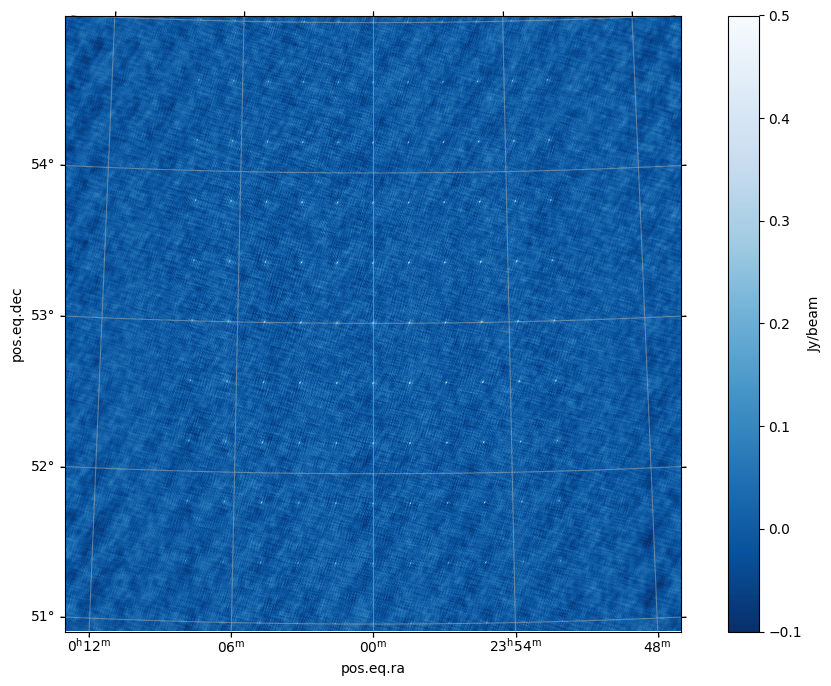
Fairly ratty image, but we defo have a grid of point source aligned with the celestial sphere, so we’re looking fine. I think lba.MS is a minimal example of the LBA array so the \(uv\) coverage probably isn’t great. Actually we can have a look at that:
with fits.open('check_positions_everybeam_LOFAR_band01.uvfits') as hdu:
    uu = (hdu[0].data['UU']*c)/1e+3
    vv = (hdu[0].data['VV']*c)/1e+3

fig, axs = plt.subplots(1, 1, figsize=(8, 8))
axs.plot(uu, vv, 'k.', ms=1)
axs.plot(-uu, -vv, 'k.', ms=1)
axs.set_xlabel('U (km)')
axs.set_ylabel('V (km)')

plt.show()
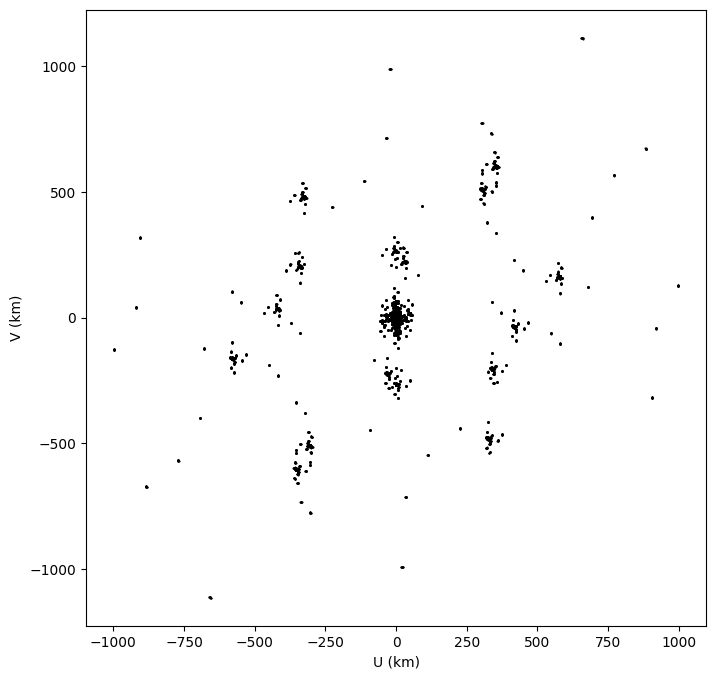
Yeah pretty patchy coverage. Amazing resolution though, blimey!