MWA dipole amplitudes and flags simulations
Note
If running hyperdrive, it is assumed you are using v3.0.0, and you have pointed $MWA_BEAM_FILE to the interpolated MWA FEE h5 file.
MWA dipole flagging
MWA receiving elements (tiles) are 4 by 4 sets of cross-dipoles. Due to the harsh nature of the Inyarrimanha Ilgari Bundara, our Murchison Radio-astronomy Observatory, sometimes these dipoles die. When they do, they are flagged as inoperable within the metafits file. For full details, see ; in short, any value in the Delays column in TILEDATA with a value of 32 is flagged.
Here we run two simulation with and without these flags. By default, WODEN runs without the flags. In this simulation we use a single 1 Jy flat spectrum point source, at the phase centre, and very close to zenith. This means without dipole flags, all visibilities should come out close to a 1Jy amplitude. With dipole flags, some visibilities should be less than 1 Jy, given less signal is collected from tiles with missing dipoles:
SRCLIST=srclist_singlepoint_power.yaml
META=../metafits/1126115208_metafits.fits

time run_woden.py \
  --ra0=0.0 --dec0=-27.0 \
  --num_freq_channels=32 --num_time_steps=14 \
  --freq_res=40e+3 --time_res=8.0 \
  --cat_filename=srclist_singlepoint_power.yaml \
  --metafits_filename=$META \
  --band_nums=1 \
  --output_uvfits_prepend=woden_dipflags \
  --primary_beam=MWA_FEE_interp \
  --lowest_channel_freq=181.775e+6 \
  --use_MWA_dipflags

time run_woden.py \
  --ra0=0.0 --dec0=-27.0 \
  --num_freq_channels=32 --num_time_steps=14 \
  --freq_res=40e+3 --time_res=8.0 \
  --cat_filename=srclist_singlepoint_power.yaml \
  --metafits_filename=$META \
  --band_nums=1 \
  --output_uvfits_prepend=woden_noflags \
  --primary_beam=MWA_FEE_interp \
  --lowest_channel_freq=181.775e+6
We also run hyperdrive as a point of comparison:
hyperdrive vis-simulate \
  -s $SRCLIST -m $METAFITS \
  --freq-res $FINE_CHAN_RES --num-fine-channels $NCHANS \
  --num-timesteps 14 \
  -o hyperdrive_dipflags.uvfits

hyperdrive vis-simulate \
  -s $SRCLIST -m $METAFITS \
  --freq-res $FINE_CHAN_RES --num-fine-channels $NCHANS \
  --num-timesteps 14 --unity-dipole-gains \
  -o hyperdrive_noflags.uvfits
If we run python compare_dipole_amps.py, we get the following report and plot, again showing that WODEN and hyperdrive agree to within an absolute tolerance of 5e-6 Jy:
Perfect beams real E-W all close?  True
Perfect beams imag E-W all close?  True
Perfect beams real N-S all close?  True
Perfect beams imag N-S all close?  True
Deformed beams real E-W all close?  True
Deformed beams imag E-W all close?  True
Deformed beams real N-S all close?  True
Deformed beams imag N-S all close?  True
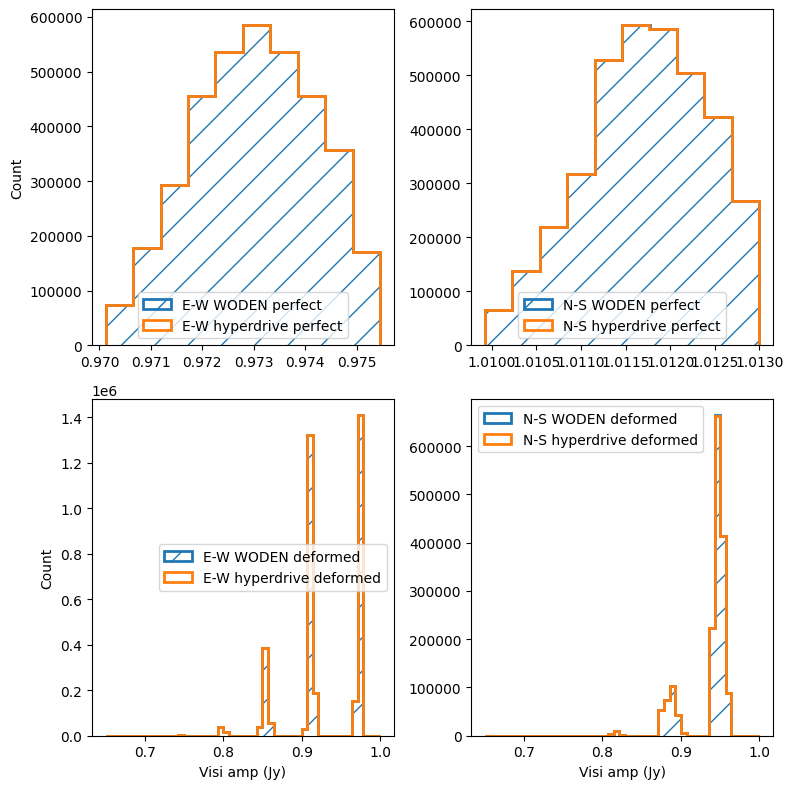
We can see groups of visibilities that have a combination of one or both tiles with one or more missing dipoles as expected in the bottom row of these amplitude histograms.
MWA dipole amplitudes
It’s also possible to feed bespoke dipole amplitudes to the MWA FEE beam, by including a Dipamps column in the TILEDATA table. This should be a (16 by num tiles) array of floats, with values between 0 and 1. The first row corresponds to 16 amplitudes of the E-W polarisation of the first tile, second row the N-S polarisation of the first tile, and so on. We repeat the same simulation and comparison to hyperdrive as for the dipole flags, with a metafits file that includes the dipole amplitudes:
time run_woden.py \
  --ra0=0.0 --dec0=-27.0 \
  --num_freq_channels=32 --num_time_steps=14 \
  --freq_res=40e+3 --time_res=8.0 \
  --cat_filename=srclist_singlepoint_power.yaml \
  --metafits_filename=$META \
  --band_nums=1 \
  --output_uvfits_prepend=woden_dipamps \
  --primary_beam=MWA_FEE_interp \
  --lowest_channel_freq=181.775e+6 \
  --use_MWA_dipamps


time run_woden.py \
    --ra0=0.0 --dec0=-27.0 \
    --num_freq_channels=32 --num_time_steps=14 \
    --freq_res=40e+3 --time_res=8.0 \
    --cat_filename=srclist_singlepoint_power.yaml \
    --metafits_filename=$META \
    --band_nums=1 \
    --output_uvfits_prepend=woden_default \
    --primary_beam=MWA_FEE_interp \
    --lowest_channel_freq=181.775e+6

SRCLIST=srclist_singlepoint_power.yaml
METAFITS=../metafits/1088285600_DipAmps.metafits
FINE_CHAN_RES=40
NCHANS=32

hyperdrive vis-simulate \
    -s $SRCLIST -m $METAFITS \
    --freq-res $FINE_CHAN_RES --num-fine-channels $NCHANS \
    --num-timesteps 14 \
    -o hyperdrive_dipamps.uvfits

hyperdrive vis-simulate \
    -s $SRCLIST -m $METAFITS \
    --freq-res $FINE_CHAN_RES --num-fine-channels $NCHANS \
    --num-timesteps 14 --unity-dipole-gains \
    -o hyperdrive_perfect.uvfits
If we run python compare_dipole_amps.py, we get the following report and plot, again showing that WODEN and hyperdrive agree to within an absolute tolerance or 1e-6 Jy:
Perfect beams real E-W all close?  True
Perfect beams imag E-W all close?  True
Perfect beams real N-S all close?  True
Perfect beams imag N-S all close?  True
Deformed beams real E-W all close?  True
Deformed beams imag E-W all close?  True
Deformed beams real N-S all close?  True
Deformed beams imag N-S all close?  True
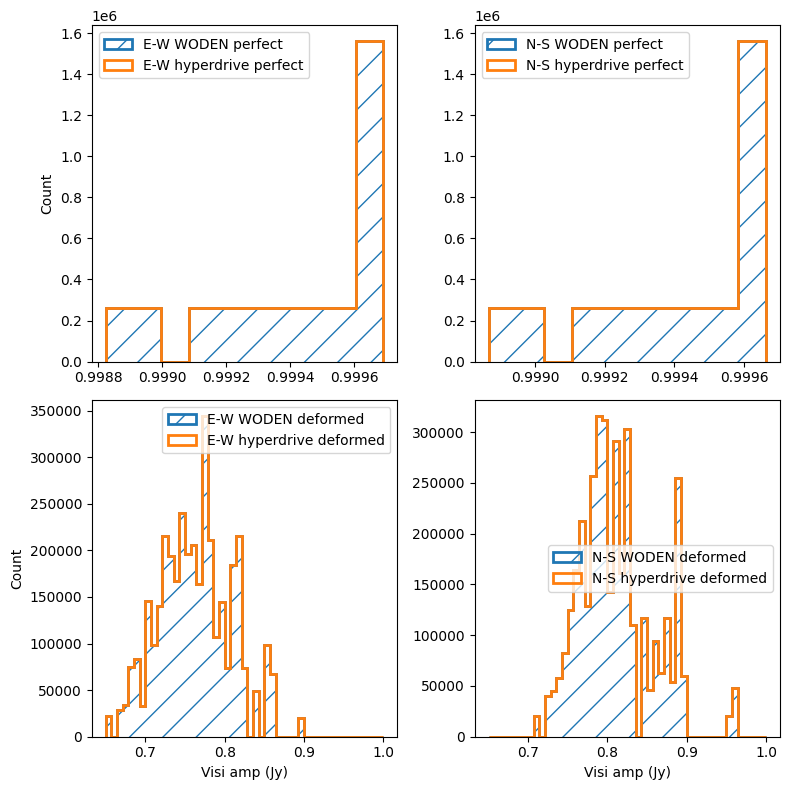
The various dipole amplitudes not only change the gain of each tile, but the shape of each primary beam, leading to a more complex distribution in the amplitude histograms.