FEE_primary_beam_cuda
Tests for the functions in WODEN/src/FEE_primary_beam_cuda.cu. This is more
of an integration test rather than a suite of individual function tests.
test_RTS_FEE_beam.c
This runs create_sky_model::test_RTS_CUDA_FEE_beam, which in turn calls
the following functions:
create_sky_model::get_HDFBeam_normalisation- get values to normalise to zenith
create_sky_model::copy_FEE_primary_beam_to_GPU- move values from host to device
create_sky_model::calc_CUDA_FEE_beam- calculate the MWA FEE beam response
create_sky_model::free_FEE_primary_beam_from_GPU- free things from the device
after copying the MWA FEE beam values from the device back to the host for testing.
The MWA beam pointing direction on the sky is controlled by a set of 16 delays.
In these tests, three different delays settings are tested at 50MHz, 150MHz, and
250MHz (a total of nine tests). Each test is run with ~5000 sky directions,
spanning the whole sky. For each combination of settings, the beam gains
output by test_RTS_CUDA_FEE_beam are compared to those stored in the header
test_RTS_FEE_beam.h.
That header test_RTS_FEE_beam.h is stitched together from values stored
in text files like hyperbeam_zenith_200.txt and hyperbeam_zenith_200_rot.txt,
which are generated using the script compare_to_hyperdrive.py using the
python package mwa_hyperbeam. Each text file stores the az/za, real and imaginary
values for the gain and leakage for both the north-south and east-west dipoles,
either with the parallactic angle rotation applied or not.
All delay and frequency combinations are run with both parallactic angle rotation
applied and not. For the FLOAT precision, the real and imaginary must match
the hyperbeam values to within a absolute tolerance of 3e-2. For DOUBLE,
they must match to within 1e-13.
Note
Given that the accuracy of the FLOAT precision is <= 3%, I suggest if you are comparing simulated visibilities to real data, that DOUBLE is the only way to go (which is accurate to <= 0.00000000001%). However, if you are running some comparison simulations, the inaccuracy is a constant bias, and is still a good representation of the beam model, so is probably fine for internal comparison.
To convince yourself sensible values are stored in those test files, a very rough
plotting script is included in as WODEN/cmake_testing/FEE_primary_beam_cuda/plot_beam_results.py,
which converts the beam gains and leakages into Stokes
XX and YY polarisations, assuming a fully Stokes I sky. The script can be used
as:
python plot_beam_results.py hyperbeam_zenith_200_rot.txt
which will produce a plot like the below (this is log10(gain) for a parallactic rotated zenith pointing at 200 MHz).
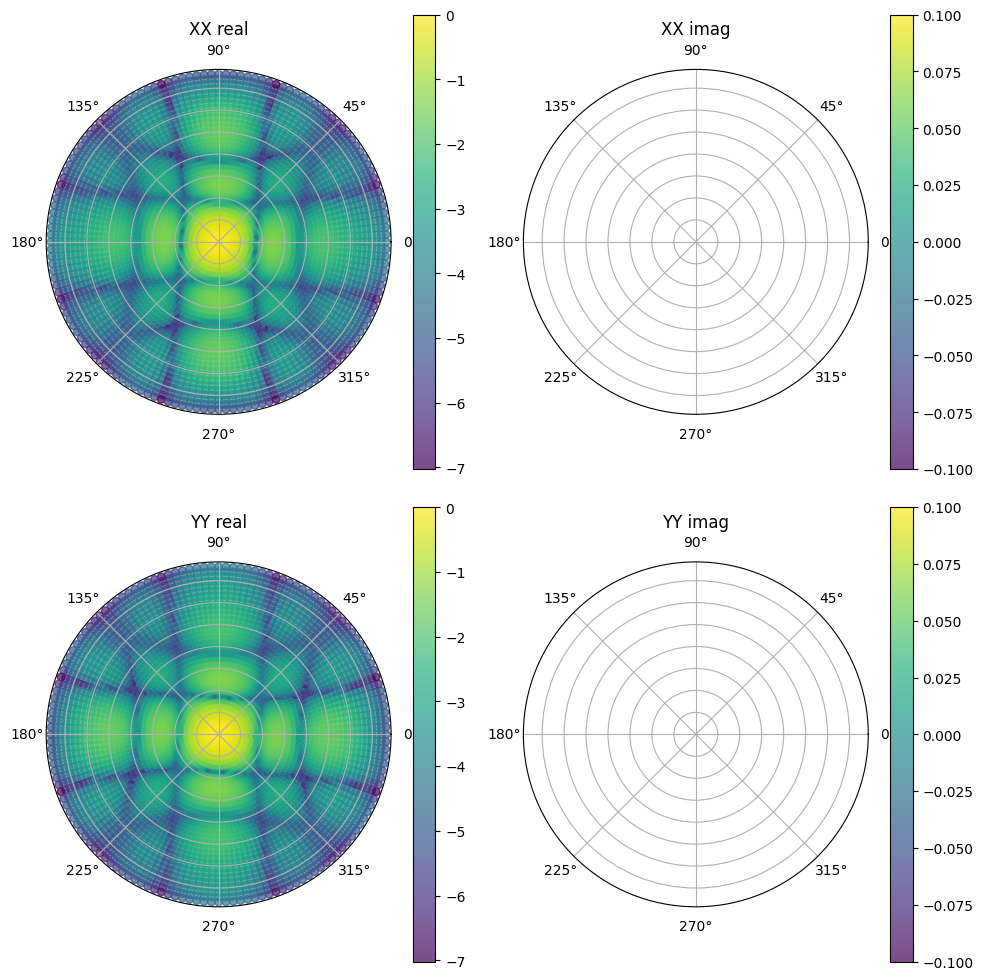
(Plot looks a little warped purely because I’ve just done a scatter plot which is a quick and dirty way of showing the info).
If you are really interested in the differences, you can run:
$ source plot_all_beam_diffs.sh
which will produce a bunch of plots in a directory
WODEN/cmake_testing/FEE_primary_beam_cuda/beam_plots. Included are difference
plots, showing the offset from the WODEN output to hyperbeam for real
and imaginary in the gain and leakage terms of the Jones matrix. An example at
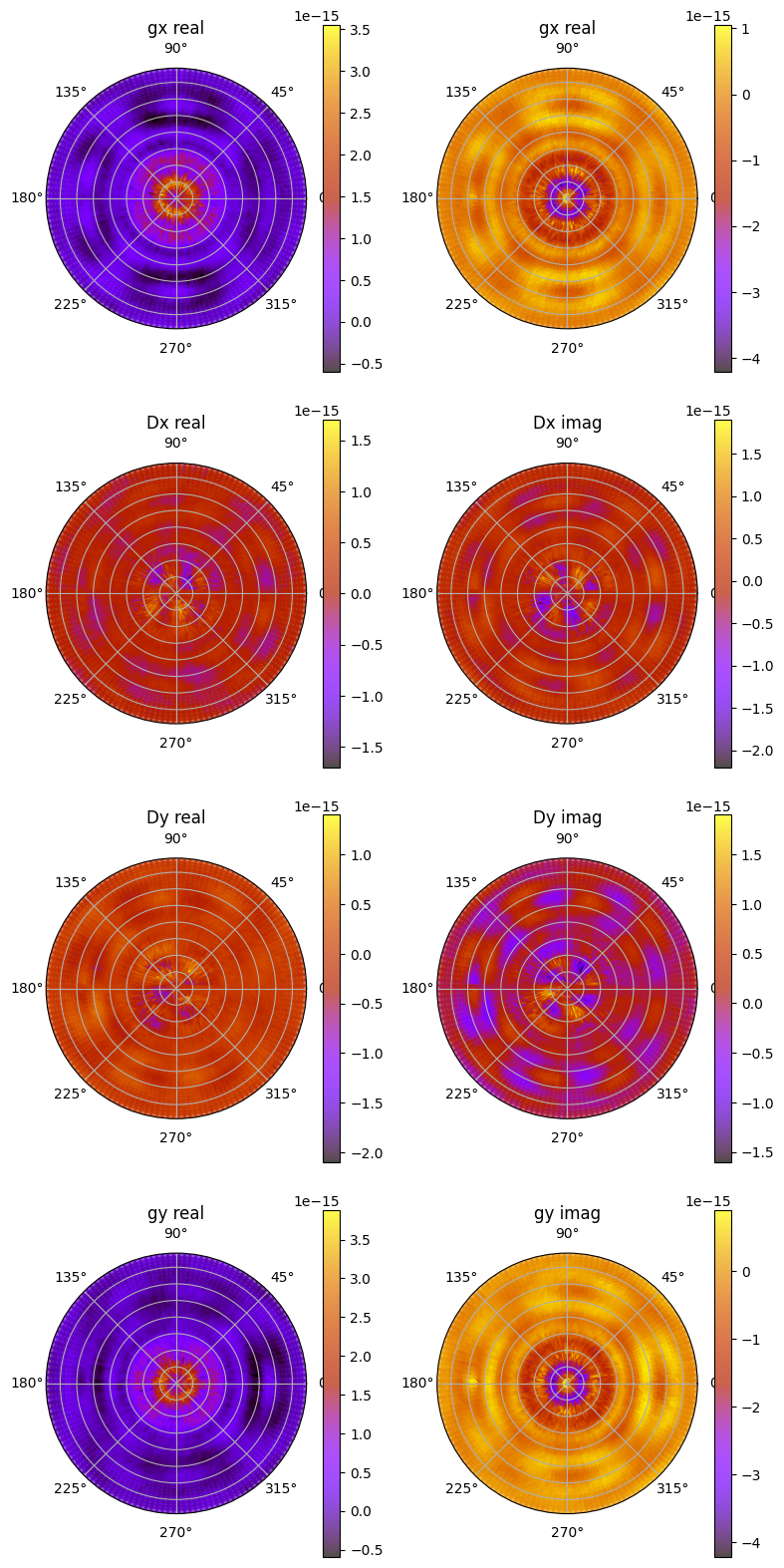
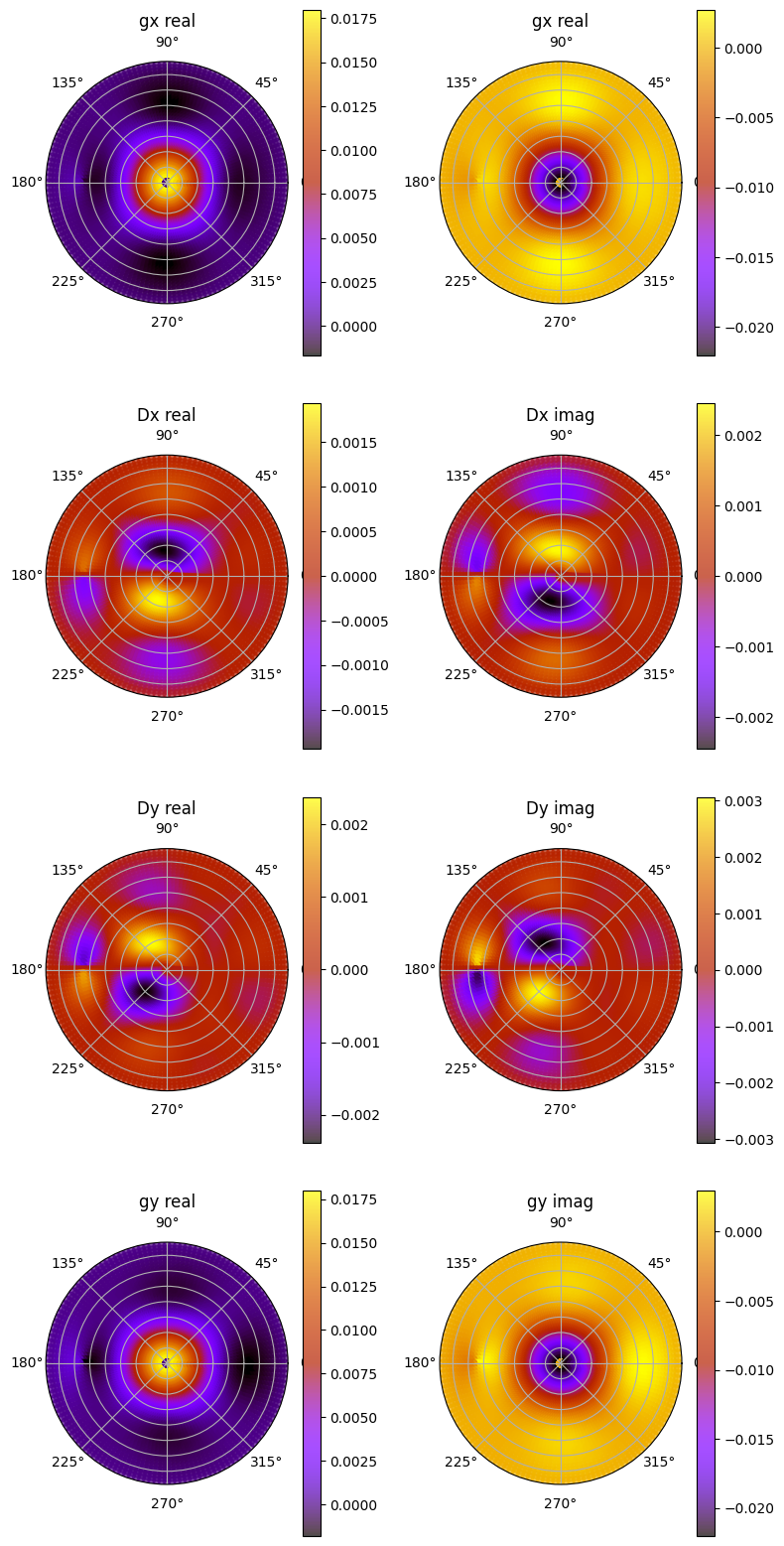
FLOAT precision for zenith at 100MHz is (note this is the difference
in gain, NOT log10(gain)):
The equivalent plot for DOUBLE is shown below, showing the vast improvement in accuracy: